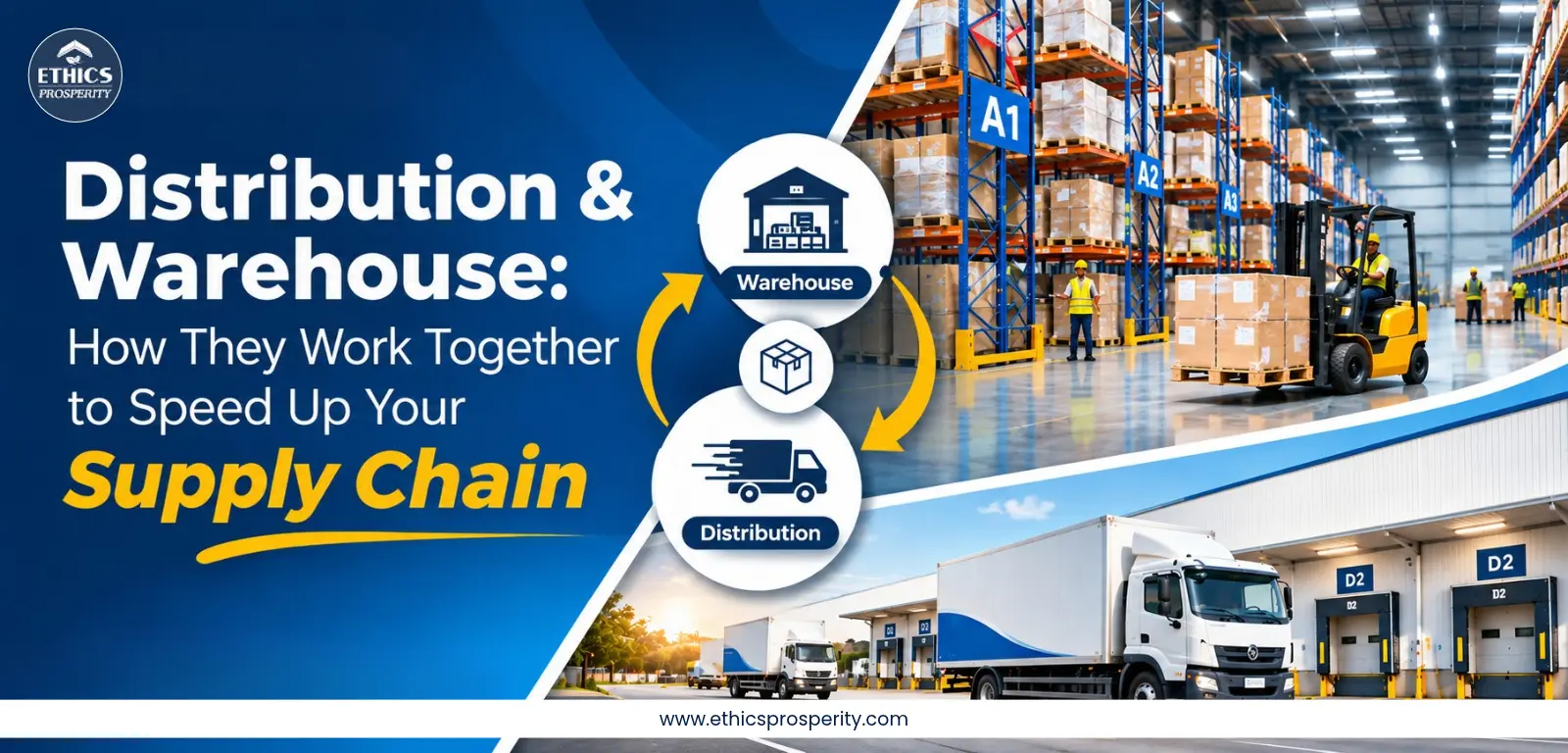
A product may be manufactured on time and customer demand may be strong, but a business can still lose sales if inventory is not stored, processed and delivered efficiently. Delays in locating stock, preparing orders or arranging transportation can affect customer commitments and increase operating costs.
This is where warehouse and distribution operations work together. A warehouse provides the space and processes required to receive, store and manage inventory. Distribution activities move that inventory through order processing, dispatch and transportation to the next destination.
For manufacturers, retailers, e-commerce businesses and distributors, the objective is not simply to store more goods or dispatch orders faster. It is to position the right inventory in the right location and move it through the network with minimum delay, handling and cost.
Understanding how Distribution & Warehouse operations complement each other helps businesses make better decisions about facility locations, inventory levels, fulfilment processes and logistics partners.
What Is Warehouse and Distribution?
Warehousing and distribution are connected functions, but they serve different operational purposes. Warehousing focuses on inventory storage and control, while distribution focuses on the movement of goods to customers, retailers, dealers or other business locations.
Together, they support a more responsive and organised logistics network.
What Does a Warehouse Do?
A warehouse is a facility where goods are received, inspected, stored and managed until they are required for production, replenishment or customer orders.
Its main responsibilities include:
-
Receiving: Checking incoming goods against purchase orders, delivery documents and expected quantities.
-
Inspection: Identifying damaged, incorrect or non-compliant products before they enter available inventory.
-
Storage: Assigning products to suitable locations based on size, handling requirements, demand and storage conditions.
-
Inventory control: Tracking stock movement, batch details, expiry dates and available quantities.
-
Replenishment: Moving stock from reserve storage to picking locations when required.
A well-managed warehouse gives businesses visibility into stock availability and reduces the risk of misplaced, damaged or unavailable inventory.
What Does Distribution Involve?
Distribution covers the activities required to move products from a warehouse, distribution centre or manufacturing location to their intended destination.
It may involve order allocation, picking, packing, dispatch planning, transportation, delivery tracking and proof of delivery.
For example, an FMCG manufacturer may store finished goods at a regional facility and distribute them to dealers and retail outlets based on demand. An e-commerce business may process individual customer orders and dispatch parcels through a delivery network.
Effective Distribution Management helps coordinate inventory availability, order priorities, dispatch schedules and transportation capacity so that deliveries meet agreed service commitments.
Warehouse vs. Distribution Center
A warehouse and a distribution centre may look similar because both handle inventory. Their operating priorities, however, are different.
A warehouse is generally designed to hold inventory for a period of time. A distribution centre places greater emphasis on processing orders and moving products through the facility quickly.
Key Differences Between a Warehouse and a Distribution Centre
|
Comparison factor |
Warehouse |
Distribution centre |
|
Primary purpose |
Store and control inventory |
Process and distribute orders |
|
Inventory movement |
May be relatively slow |
Generally faster |
|
Storage period |
Can be longer |
Usually shorter, depending on the model |
|
Main activities |
Receiving, put-away, storage and stock control |
Picking, packing, sorting and dispatch |
|
Operating focus |
Storage accuracy and inventory availability |
Order speed and delivery performance |
|
Typical use |
Seasonal stock, raw materials and reserve inventory |
Retail replenishment and e-commerce fulfilment |
The distinction is not absolute. Many modern facilities combine storage and distribution functions. The right design depends on product characteristics, order volumes, demand patterns and delivery requirements.
How the Warehouse Distribution Process Works
An effective warehouse distribution process connects inbound goods with outbound customer or business orders. Each stage needs accurate information and clear operational responsibility.
1. Receiving and Inbound Checks
The process begins when goods arrive at the facility. Warehouse teams verify quantities, product codes, packaging condition and relevant documentation.
Discrepancies should be recorded before stock is accepted into the inventory system. This prevents incorrect quantities or damaged products from affecting later order fulfilment.
2. Storage and Inventory Control
After receiving, products are assigned to storage locations. The placement decision should consider product dimensions, weight, handling requirements, movement frequency and compatibility with other goods.
Fast-moving products may be positioned closer to picking and dispatch areas, while slower-moving inventory can be assigned to suitable reserve locations.
Businesses using barcode scanning, warehouse management systems (WMS) and regular cycle counts can improve stock accuracy and reduce the time employees spend searching for products.
3. Order Processing and Picking
When an order is received, the system checks stock availability and releases the required picking instructions.
Depending on order volume and facility design, businesses may use:
-
Single-order picking: One order is picked at a time.
-
Batch picking: Items for multiple orders are collected together.
-
Zone picking: Employees pick products from designated warehouse zones.
-
Wave picking: Orders are released in planned groups based on dispatch schedules or carrier cut-off times.
The best method depends on order size, product variety, labour availability and required dispatch speed.
4. Packing, Dispatch and Transportation
Picked items are checked, packed and labelled according to customer, carrier and product requirements. Orders are then consolidated where appropriate and assigned to vehicles or transportation partners.
Dispatch planning should consider vehicle capacity, delivery locations, delivery time windows and route priorities. Poor coordination at this stage can create loading delays, missed cut-off times and additional transportation costs.
5. Returns and Reverse Logistics
The process does not end when an order leaves the facility. Returned goods may need inspection, sorting, repacking, restocking, repair or disposal.
A defined returns process helps businesses recover usable inventory, identify recurring product or packaging issues and maintain accurate stock records.
When these stages are connected through reliable Supply chain management, businesses can improve visibility from inbound receipt to final dispatch.
Warehouse, Distribution Center, or Both?
There is no single facility model that suits every business. The decision should be based on demand patterns, product characteristics, inventory holding requirements, delivery geography and service expectations.
When a Warehouse Is the Better Choice
A warehouse may be more suitable when a business needs to:
-
Hold raw materials or finished goods for longer periods.
-
Maintain buffer stock against demand fluctuations.
-
Store seasonal or slow-moving inventory.
-
Support manufacturing or production schedules.
-
Consolidate inventory before regional replenishment.
For example, a manufacturer may use a central warehouse to hold finished goods and release stock to regional facilities according to sales forecasts.
When a Distribution Centre Is More Suitable
A distribution centre may be the better option when the priority is frequent order processing and rapid movement of products.
It can support:
-
Retail store replenishment.
-
High-volume e-commerce orders.
-
Multi-location order distribution.
-
Product sorting and shipment consolidation.
-
Time-sensitive dispatch operations.
A regional distribution centre can also bring inventory closer to key customer markets, potentially reducing delivery lead times.
When an Integrated Model Works Best
Many businesses need both storage and rapid distribution. An integrated facility can hold reserve inventory while maintaining dedicated space for picking, packing and dispatch.
This model can be useful for businesses handling different product categories, fluctuating order volumes or multiple customer channels. An effective End-to-end supply chain design connects procurement, storage, order fulfilment and transportation rather than optimising each function in isolation.
The facility layout, technology and workforce plan should reflect the actual flow of goods. Simply adding storage capacity will not solve dispatch bottlenecks if picking or loading areas are already constrained.
When to Outsource to a 3PL
Managing a warehouse and distribution network internally requires investment in facilities, people, technology, equipment and transportation coordination. For some businesses, outsourcing these activities to a third-party logistics provider (3PL) can provide access to established infrastructure and operational expertise.
Signs Your Business May Need a 3PL
Outsourcing may be worth evaluating when:
-
Order volumes are growing faster than internal capacity.
-
Warehouse space is insufficient or poorly located.
-
Delivery performance is inconsistent across regions.
-
Seasonal demand creates short-term capacity pressure.
-
Managing multiple facilities and transport partners is becoming complex.
-
The business wants to focus more resources on manufacturing, sales or product development.
A 3PL arrangement can cover storage, inventory handling, order fulfilment, transportation or a combination of these services. The scope should be defined clearly in the service agreement.
What to Evaluate Before Selecting a Partner
Do not select a logistics partner based only on warehouse size or quoted storage rates. Assess its ability to meet your operating requirements.
Important evaluation factors include:
-
Facility location: Is the facility close to suppliers, manufacturing sites or customer markets?
-
Storage capability: Can it handle the product's dimensions, weight and special storage requirements?
-
Technology: Does it provide inventory visibility, order tracking and system integration?
-
Operational capacity: Can it manage normal and peak-period volumes?
-
Service performance: Are order accuracy, dispatch timelines and delivery performance measured?
-
Scalability: Can the provider support additional locations, products or channels as the business grows?
-
Commercial transparency: Are handling, storage, transportation and additional service charges clearly defined?
Businesses comparing supply chain companies should also review relevant industry experience, customer references, escalation processes and the provider's ability to report performance against agreed service-level agreements (SLAs).
For organisations researching the top 10 warehousing companies in Gurugram, a useful starting point is to compare providers against actual operational requirements rather than relying on rankings alone. Location, sector expertise, technology, capacity and service consistency are more meaningful selection criteria.
Conclusion
Warehousing and distribution are not independent activities. They are connected parts of a logistics operation that determine how accurately inventory is stored, how efficiently orders are processed and how reliably goods reach their destinations.
The right combination depends on business requirements. Some organisations need long-term storage, others need fast-moving distribution facilities, and many benefit from an integrated model supported by a capable 3PL partner.
Businesses should evaluate facility location, inventory visibility, order volumes, handling processes and delivery performance before making infrastructure decisions. With the right operating model and measurable service standards, Ethics Prosperity can support businesses in developing warehousing and distribution operations that align with their supply chain requirements.