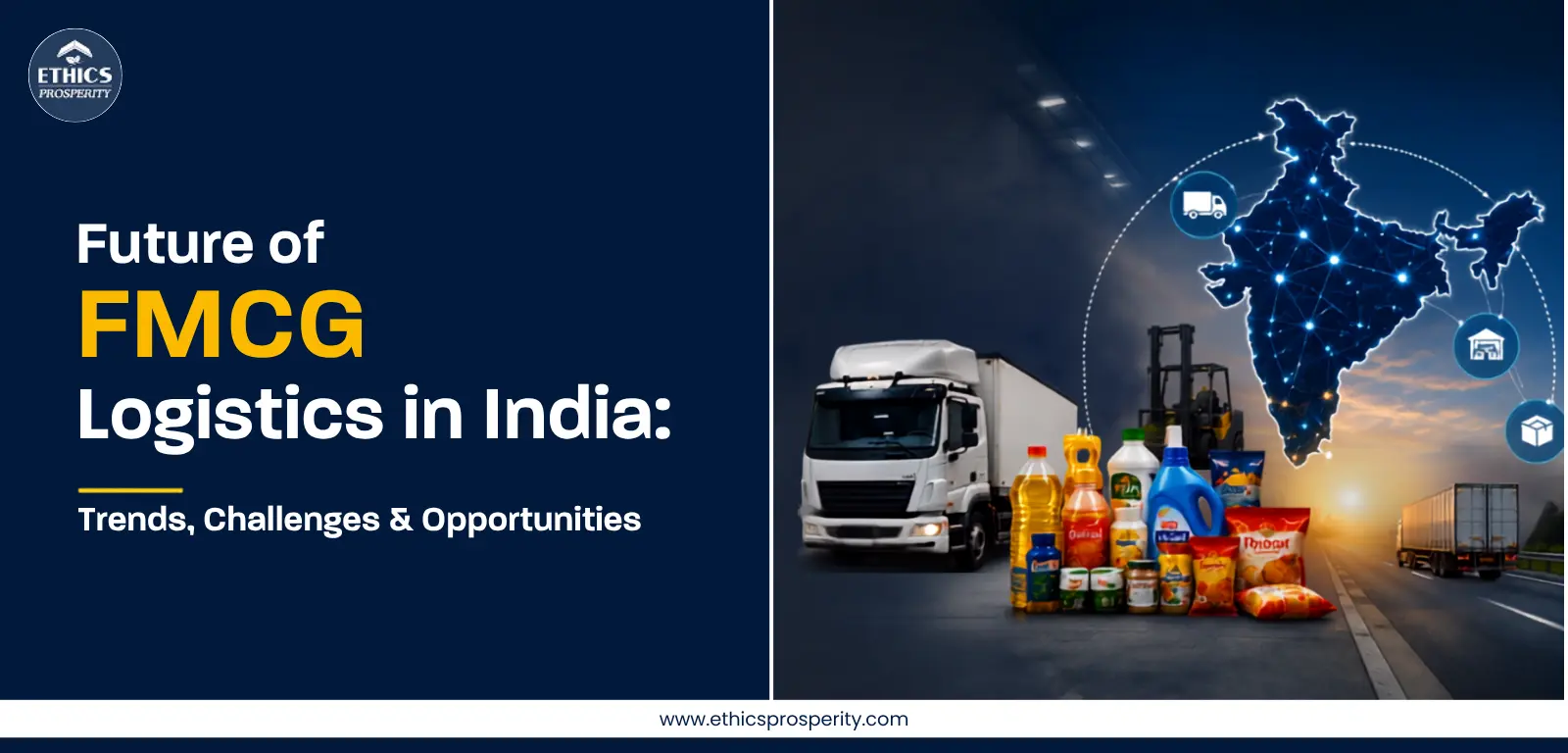
FMCG distribution operates under a different set of pressures from many other supply chain segments. Products move frequently, margins can be tight, demand varies by geography, and availability at the right retail outlet can directly influence sales.
For manufacturers, distributors, retailers, and logistics providers, the challenge is not simply moving products from one location to another. The objective is to maintain product availability, freshness, inventory efficiency, service levels, and cost control simultaneously.
India's rapidly changing consumption patterns are making this challenge more complex.
E-commerce, organized retail, quick commerce, regional consumption patterns, urbanization, and rising customer expectations are changing how FMCG networks are designed and operated.
The future of FMCG Logistics will therefore depend on how effectively businesses connect demand planning, inventory, warehousing, transportation, technology, and distribution.
What Is FMCG Logistics?
FMCG logistics covers the planning and execution of activities required to move fast-moving consumer goods from manufacturers and suppliers through distribution networks to retailers, fulfillment points, and ultimately consumers.
A typical flow can include:
Supplier → Manufacturing → Primary Distribution → Warehouse → Distributor → Retailer → Consumer
The exact structure varies by product category and business model.
A large FMCG organization may operate multiple distribution centers and regional warehouses, while a digitally native consumer brand may rely more heavily on third-party fulfillment and direct-to-consumer distribution.
Unlike slow-moving products, FMCG products often require frequent replenishment. Products may also have shelf-life, temperature, packaging, handling, or regulatory considerations.
This makes Supply chain management a continuous balancing exercise between service levels and working capital.
Key Trends Shaping the Future of FMCG Logistics in India
1. Faster Replenishment Is Becoming a Competitive Requirement
Retailers increasingly expect reliable and frequent replenishment.
Stock-outs can mean lost sales, while excessive inventory increases holding costs and the risk of ageing or expiry.
The solution is not simply maintaining more stock. Businesses need better demand signals, appropriate safety-stock policies, accurate inventory records, and faster replenishment cycles.
2. Quick Commerce Is Changing Urban Distribution
Quick-commerce growth has introduced tighter delivery expectations in major cities.
For suitable product categories, inventory may need to be positioned closer to consumption centers rather than relying entirely on large regional distribution centers.
This is increasing interest in localized fulfillment models and hyperlocal delivery networks.
However, speed must be evaluated against economics. A very dense network can reduce delivery distances while simultaneously increasing facility, labor, and inventory costs.
The right model depends on order density, SKU velocity, customer geography, and service expectations.
3. Warehousing Is Moving Closer to Demand
The traditional approach of concentrating inventory in a small number of large facilities is being complemented by more distributed networks.
Regional warehouses, fulfillment centers, and urban stocking locations can help companies respond faster to local demand.
For warehousing and logistics, this creates a need for stronger coordination between inventory positioning and transportation planning.
4. Demand Planning Is Becoming More Data-Driven
FMCG demand can vary because of seasonality, promotions, weather, local events, pricing, competitor activity, and consumer behavior.
Historical sales data alone may not always provide enough visibility.
Companies are increasingly combining sales data with operational and market signals to improve forecasting and replenishment decisions.
The objective is to reduce both stock-outs and excess inventory.
5. Sustainability Is Becoming an Operational Issue
Sustainability in FMCG distribution is moving beyond corporate reporting.
Fuel consumption, vehicle utilization, packaging, route efficiency, warehouse energy consumption, and reverse movement all affect both environmental impact and operating cost.
In many cases, reducing empty vehicle kilometers or improving load utilization can support sustainability while also improving transportation economics.
Major Challenges in FMCG Logistics
Demand Volatility
FMCG demand can change quickly across products and regions.
Promotional campaigns may generate temporary spikes, while changes in consumer preferences can reduce demand for individual SKUs.
Planning systems therefore need to distinguish between sustainable demand changes and short-term fluctuations.
Inventory and Shelf-Life Management
Holding too much stock can increase working capital and product ageing.
Holding too little creates stock-out risk.
This makes inventory rotation, batch tracking, expiry monitoring, and replenishment discipline particularly important for relevant FMCG categories.
Transportation Cost and Utilization
Transportation can represent a significant portion of distribution costs.
Poor route planning, low vehicle utilization, fragmented deliveries, congestion, and inefficient dispatch scheduling can increase the cost per shipment.
The focus should therefore move from simply negotiating freight rates to managing the total cost of distribution.
Urban Delivery Constraints
Congestion, restricted delivery windows, limited parking, and increasing order density make urban distribution operationally demanding.
This is particularly relevant as businesses expand direct-to-consumer and rapid-delivery channels.
Fragmented Distribution Networks
FMCG distribution may involve manufacturers, distributors, wholesalers, retailers, modern trade, e-commerce platforms, and local delivery partners.
Without common data and clear processes, information gaps can develop between network participants.
Role of Technology in the Future of FMCG Logistics
Technology is becoming an operational enabler rather than simply an IT investment.
Warehouse Visibility
A properly implemented Warehouse Management System can provide greater control over receiving, put-away, picking, dispatch, stock locations, and inventory transactions.
For FMCG businesses, this visibility can support better replenishment and reduce discrepancies between system inventory and physical stock.
AI and Predictive Planning
AI can help analyze large volumes of demand and operational data to identify patterns that may be difficult to detect manually.
Potential applications include:
-
Demand forecasting
-
Replenishment planning
-
Route optimization
-
Inventory segmentation
-
Anomaly detection
-
Capacity planning
AI should not replace operational judgment. Forecast outputs need to be validated against business conditions such as promotions, product launches, market disruptions, and known supply constraints.
IoT and Real-Time Monitoring
Connected devices can provide visibility into vehicles, equipment, warehouse conditions, and shipment status.
For temperature-sensitive FMCG categories, monitoring can help identify deviations before they become larger quality or compliance problems.
Automation
Automation can improve throughput and reduce repetitive manual activity where volumes justify the investment.
Potential applications include automated sorting, conveyor systems, scanning, picking assistance, and inventory movement.
The correct approach is to automate processes that create measurable operational value rather than adopting technology without a defined business case.
Opportunities for FMCG Companies and Logistics Providers
The evolving FMCG market creates opportunities across the entire distribution network.
For FMCG Manufacturers
Manufacturers can improve distribution performance by:
-
Segmenting inventory by demand velocity
-
Improving demand planning
-
Optimizing distribution-center locations
-
Integrating distributor data
-
Improving transport utilization
For Logistics Providers
Third-party providers can differentiate through:
-
Better inventory visibility
-
Multi-client warehousing
-
Technology-enabled fulfillment
-
Flexible transportation
-
Industry-specific operating models
-
Data-driven performance reporting
The role of Logistics companies in India is increasingly moving from transportation execution toward integrated supply chain support.
How FMCG Logistics Can Become More Efficient
Efficiency should be measured across the network rather than at a single warehouse or transportation activity.
A practical improvement program should begin with five areas.
1. Measure the Right KPIs
Useful metrics include:
-
Order fill rate
-
On-time delivery
-
Inventory accuracy
-
Stock-out rate
-
Warehouse productivity
-
Vehicle utilization
-
Cost per case/order
-
Inventory days
-
Damage and return rate
2. Segment Products
Not every SKU needs the same inventory policy.
High-volume products may require frequent replenishment and strategic positioning, while slower products may be consolidated into fewer locations.
3. Integrate Data
Sales, inventory, warehouse, transportation, and order data should be connected wherever possible.
A fragmented data environment makes it difficult to identify the real cause of service failures.
4. Optimize the Network
Businesses should periodically review whether their warehouse and distribution-center locations still match current demand.
Consumer markets change. A network that was efficient five years ago may not be optimal today.
5. Balance Cost With Service
The lowest logistics cost is not necessarily the best outcome.
If reducing warehouse or transportation expenditure causes frequent stock-outs and lost sales, the apparent saving may become a larger commercial cost.
The goal is an economically sustainable service model.
Conclusion
The future of FMCG distribution in India will be shaped by a combination of faster fulfillment expectations, changing consumer behavior, distributed inventory networks, technology adoption, and greater pressure on cost and sustainability.
The strongest businesses will not treat warehousing, transportation, inventory, and fulfillment as isolated functions. They will connect them as part of a responsive End-to-end supply chain.
For decision-makers, the priority should be to build a network that can adapt to demand without creating unnecessary inventory, capacity, or transportation costs.
As India's FMCG market becomes increasingly competitive, companies such as Ethics Prosperity can strengthen their relevance by combining operational discipline, technology, scalable infrastructure, and measurable service performance to help businesses build more responsive distribution networks.