Effective supply chain inventory management is essential for keeping operations efficient, cost effective and responsive in today’s competitive environment. By combining strong inventory optimization, practical stock control techniques and data-driven inventory management strategies, businesses can manage different types of inventory with greater accuracy and speed. Modern tools such as a warehouse management system and improved supply chain visibility enable seamless end to end supply chain coordination, supporting better demand forecasting, timely inventory replenishment and stronger logistics and warehousing performance. When applied well, these practices enhance overall supply chain optimization and help companies reduce costs, prevent stockouts and improve service levels across the value chain.
What Is Inventory Management?
Inventory management is the process of tracking and controlling goods across the business, ensuring all types of inventory move smoothly through the end-to-end supply chain. It supports accurate stock levels, efficient warehouse management and timely purchase decisions, helping companies avoid both out of stock and overstock situations.
With strong inventory management strategies, inventory optimization, stock control techniques and better supply chain visibility, businesses can improve demand forecasting, streamline inventory replenishment and strengthen overall logistics and warehousing efficiency. Modern tools like ERP platforms and warehouse management systems further automate supply chain inventory processes, enabling smarter decisions and supporting overall supply chain optimization.
Types of Inventory in Supply Chain Operations
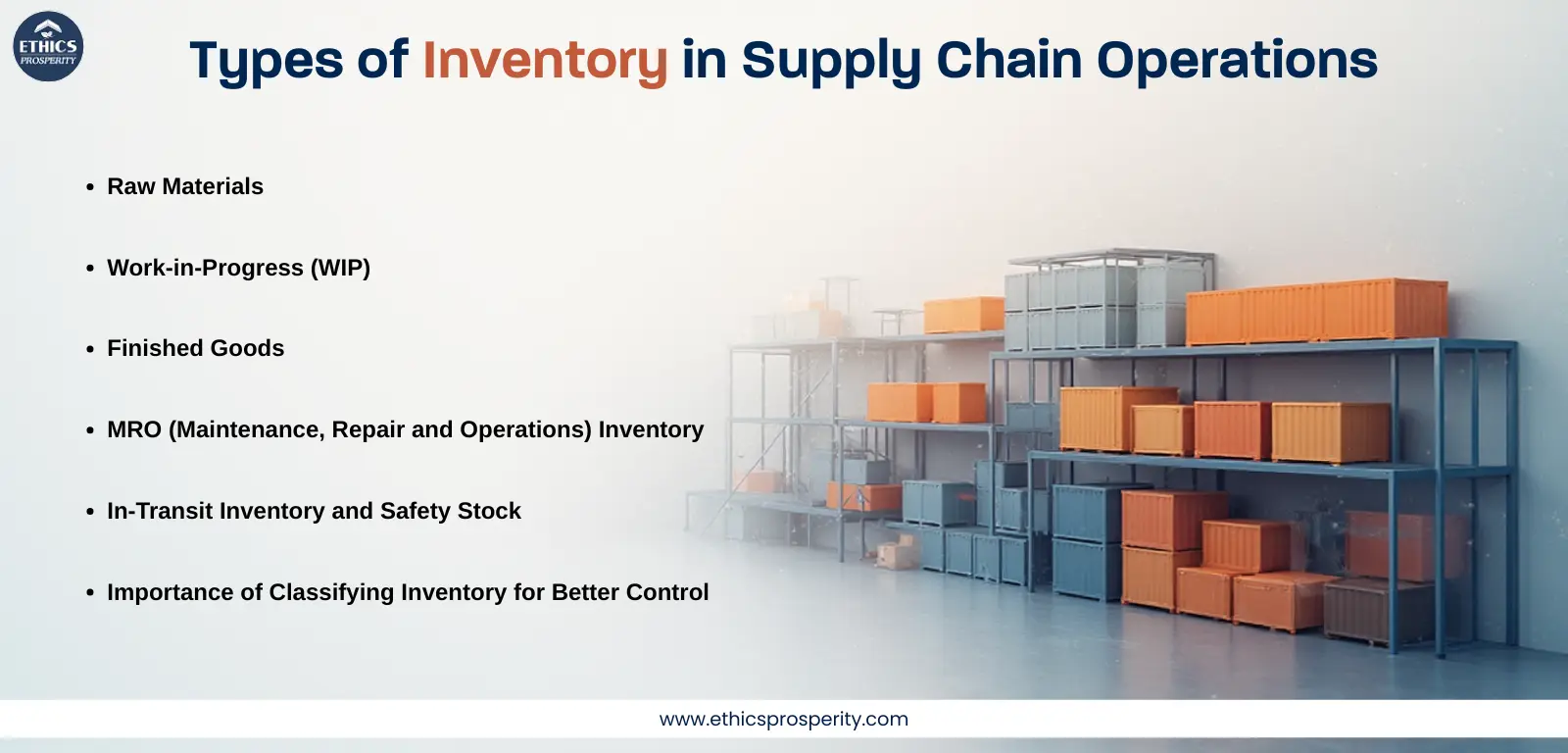
Understanding the different types of inventory in supply chain operations is essential for maintaining balanced stock levels, improving planning accuracy and ensuring smoother, more efficient flow of goods across the entire supply chain.
Raw Materials:
Raw materials are the basic inputs required to begin production. Managing this type of inventory effectively supports smoother logistics and warehousing operations and ensures that the end to end supply chain has what it needs to meet manufacturing timelines. Strong inventory management strategies help prevent shortages and improve demand forecasting accuracy.
Work-in-Progress (WIP):
Work in Progress inventory includes partially completed items moving through the production cycle. Tracking WIP is essential for supply chain visibility, reducing bottlenecks and improving inventory optimization. Using tools like a warehouse management system ensures smoother workflows across production.
Finished Goods:
Finished goods are fully completed products ready for sale or distribution. This category is a major part of supply chain inventory, and effective control helps improve customer service levels while reducing excess stock. Proper stock control techniques help align finished goods levels with real-time demand for better inventory replenishment..
MRO (Maintenance, Repair and Operations) Inventory:
MRO inventory includes tools, spare parts, cleaning materials and other items that support operations but do not become part of the final product. Proper management of MRO is crucial for uninterrupted logistics and warehousing activities and contributes to overall supply chain optimization.
In-Transit Inventory and Safety Stock:
In-transit and safety stock work together to keep the end-to-end supply chain stable by improving supply chain visibility, supporting accurate demand forecasting and ensuring smooth inventory replenishment. By optimizing both, businesses strengthen overall inventory optimization and enhance logistics and warehousing performance.
Importance of Classifying Inventory for Better Control:
Classifying inventory helps businesses track stock efficiently, improve forecasting, optimize storage space, reduce costs and strengthen overall supply chain visibility. It ensures the right inventory management strategies are applied to each category, supporting smoother operations across the end to end supply chain.
Key Components of Effective Inventory Management
Effective inventory management relies on core components that help businesses maintain accuracy, reduce costs and improve supply chain performance.
-
Inventory Tracking and Control:
Accurate tracking and control ensure real-time visibility of supply chain inventory, helping businesses manage different types of inventory more effectively. By using tools like a warehouse management system, companies strengthen stock control techniques and support smoother logistics and warehousing operations.
-
Demand Forecasting:
Demand forecasting uses data and trends to predict customer needs, enabling better inventory optimization, timely inventory replenishment and stronger end to end supply chain planning. It also enhances overall supply chain visibility and reduces the risk of stockouts or excess stock.
-
Safety Stock and Reorder Points:
Setting appropriate safety stock and reorder levels ensures uninterrupted product availability. These controls help stabilize inventory management strategies, reduce uncertainty and improve responsiveness across the entire supply chain optimization process.
-
Supplier and Vendor Management:
Effective supplier coordination ensures timely deliveries, shorter lead times and consistent quality. Strong vendor relationships support smoother flows across logistics and warehousing and enhance overall inventory optimization within the supply chain.
-
Cost Management:
Managing carrying costs, ordering costs and storage expenses helps maintain profitability while ensuring the right stock levels. Cost control supports more efficient inventory management strategies and contributes to long-term supply chain optimization.
-
Technology and Auto mation:
Modern tools like ERP platforms, automated systems and a warehouse management system improve accuracy, accelerate decision-making and enhance supply chain visibility. Automation strengthens stock control techniques, reduces manual errors and supports a more resilient end to end supply chain.
Inventory Management Step-by-Step Process
The inventory management process follows a structured sequence that helps businesses balance stock levels, reduce errors and enhance overall supply chain efficiency.
Demand Planning:
Demand planning begins with accurate demand forecasting, using historical sales, market trends, and seasonal patterns to predict future needs. This step ensures stock control, prevents stock-outs, reduces holding costs, and supports smooth inventory management and supply chain efficiency.
Ordering:
Based on forecasted demand and current inventory levels, purchase orders are created to maintain optimal stock. Effective ordering strengthens supplier coordination, improves operational efficiency, and ensures the end-to-end supply chain remains responsive and balanced.
Delivery:
Suppliers deliver goods to the warehouse, where teams perform quality checks, verify quantities, and update systems. Accurate receiving enhances real-time visibility, prevents discrepancies, and ensures products are ready for seamless handling within the supply chain.
Inventory Tracking & Storage:
Products are stored using organized shelving, FIFO/LIFO rotation, and climate-controlled warehousing where required. Using barcodes, RFID, or WMS, businesses achieve real-time tracking, enhance stock visibility, and ensure precise inventory management across the operation.
Sale:
As inventory moves out through retail, distribution, or order fulfillment, businesses ensure fast, accurate service. Sales activity directly impacts inventory levels, enabling better planning and contributing to a more efficient and agile digital supply chain.
Reviewing, Reporting & Optimization:
Key metrics like inventory turnover, stock-outs, demand accuracy, and holding costs are evaluated. Insights from reporting enhanced by automation, data analytics, and AI-driven insights help optimize stock strategies and improve overall inventory performance.
Replenishment:
Based on reorder points and consumption trends, stock is replenished to maintain healthy inventory levels. Efficient replenishment ensures product availability, reduces risk, and strengthens the responsiveness of the end-to-end supply chain, completing the inventory management cycle.
Challenges in Inventory Management in Supply Chain
Inventory management in supply chain operations faces key challenges that affect accuracy, visibility, and the ability to maintain optimal stock across the end-to-end supply chain. Those key challenges are:
1. Inaccurate Demand Forecasting:
Even small shifts in customer preferences, market trends, or seasonal changes can make demand forecasting unreliable. When forecasts are off, businesses either overestimate and build excess stock or underestimate and face stock-outs. Both outcomes disrupt inventory management, increase costs, and reduce end-to-end supply chain efficiency.
2. Lack of Real-Time Inventory Visibility:
Many organizations struggle with limited system integration and outdated tracking tools. Without real-time visibility across warehouses, stores, and distribution hubs, teams cannot see accurate inventory levels or stock movement. This leads to miscounts, misplaced items, slower decision-making, and weakened stock control throughout the supply chain.
3. High Holding and Carrying Costs:
Maintaining too much inventory drives up holding costs, including warehouse space, labor, insurance, and risk of damage or expiry. When inventory turnover slows, companies end up paying more to store products than they earn from selling them. This reduces operational efficiency and ties up capital that could be used elsewhere in the business.
4. Supply Chain Disruptions:
Unpredictable delays from suppliers, transportation challenges, weather events, or geopolitical issues can impact the flow of goods. These disruptions create sudden shortages, delay replenishment, and break the rhythm of the supply chain, making it difficult to maintain smooth inventory planning and consistent customer service levels.
5. Inefficient Replenishment and Stock Control:
When reorder points, safety stock levels, and lead times are not properly managed, replenishment becomes inconsistent. This results in premature ordering, excess inventory, or delayed stock availability. Inefficient stock control weakens inventory planning, hampers product availability, and affects overall supply chain performance.
Inventory Management Techniques Every Business Should Use
Effective inventory management techniques help strengthen supply chain operations by improving visibility, accuracy, and end-to-end efficiency. Some of its techniques are:
1. ABC Analysis:
ABC analysis categorizes inventory into high-value A items, mid-value B items, and low-value C items, helping businesses focus tighter control on the most critical stock. This technique improves end-to-end supply chain visibility, supports strategic demand planning, and boosts overall inventory management efficiency.
2. Just-in-Time (JIT) Inventory:
JIT allows companies to receive goods only when demand requires it, reducing excess stock, storage costs, and operational waste. By optimizing timing and flow, it enhances lean supply chain operations and improves responsiveness across the digital and real-time supply chain ecosystem.
3. Economic Order Quantity (EOQ):
EOQ calculates the ideal order size to balance ordering costs, carrying costs, and actual demand. This technique strengthens inventory planning accuracy, supports smarter supply chain operations, and helps maintain the right stock levels throughout the end-to-end supply chain.
4. Safety Stock Management:
Safety stock provides a buffer against unpredictable demand spikes, supplier delays, or disruptions. Effective safety stock management increases supply chain resilience, ensures product availability, and maintains a smooth flow of goods across all stages of inventory management.
5. Demand Forecasting & Replenishment Planning:
Data-driven forecasting helps businesses predict future demand patterns and align replenishment cycles accordingly. This technique enhances supply chain visibility, supports real-time decision-making, and ensures timely restocking to maintain continuous, efficient supply chain operations.
How End-to-End Supply Chain Partners like Ethics Prosperity Add Value
End to end supply chain partners like Ethics Prosperity streamline operations by integrating procurement, warehousing, transportation, and last mile delivery into a single connected ecosystem. This unified flow enhances real time visibility, strengthens demand planning, and ensures accurate and efficient inventory management across the entire supply chain. By removing operational silos and enabling transparent data movement, businesses can maintain optimal stock levels, reduce delays, and respond quickly to changing market needs.
Through technology driven solutions such as automated workflows, advanced analytics, and intelligent tracking, Ethics Prosperity improves speed, accuracy, and cost efficiency. Their scalable warehousing, multichannel fulfilment, and SLA backed performance help businesses operate with greater agility and resilience. This end to end support creates a more reliable, customer focused, and future ready supply chain.
Conclusion
Effective inventory management is essential for building a smarter and more efficient supply chain. By strengthening demand forecasting, stock control, real time visibility, and optimized inventory levels, businesses can reduce costs, prevent stockouts, and improve overall operational efficiency across the end to end supply chain.
Partners like Ethics Prosperity further elevate this process through automation, data driven planning, and integrated digital supply chain solutions. Their unified ecosystem enhances replenishment, speed, and accuracy, helping businesses operate with greater agility and deliver a future ready supply chain experience.