Retail fulfillment has changed significantly as consumers increasingly expect products to be available quickly, accurately, and at convenient delivery times. For retailers, meeting these expectations requires more than adding delivery vehicles. The physical location of inventory has become an important part of fulfillment strategy.
This is where Dark Stores have emerged as a practical operating model.
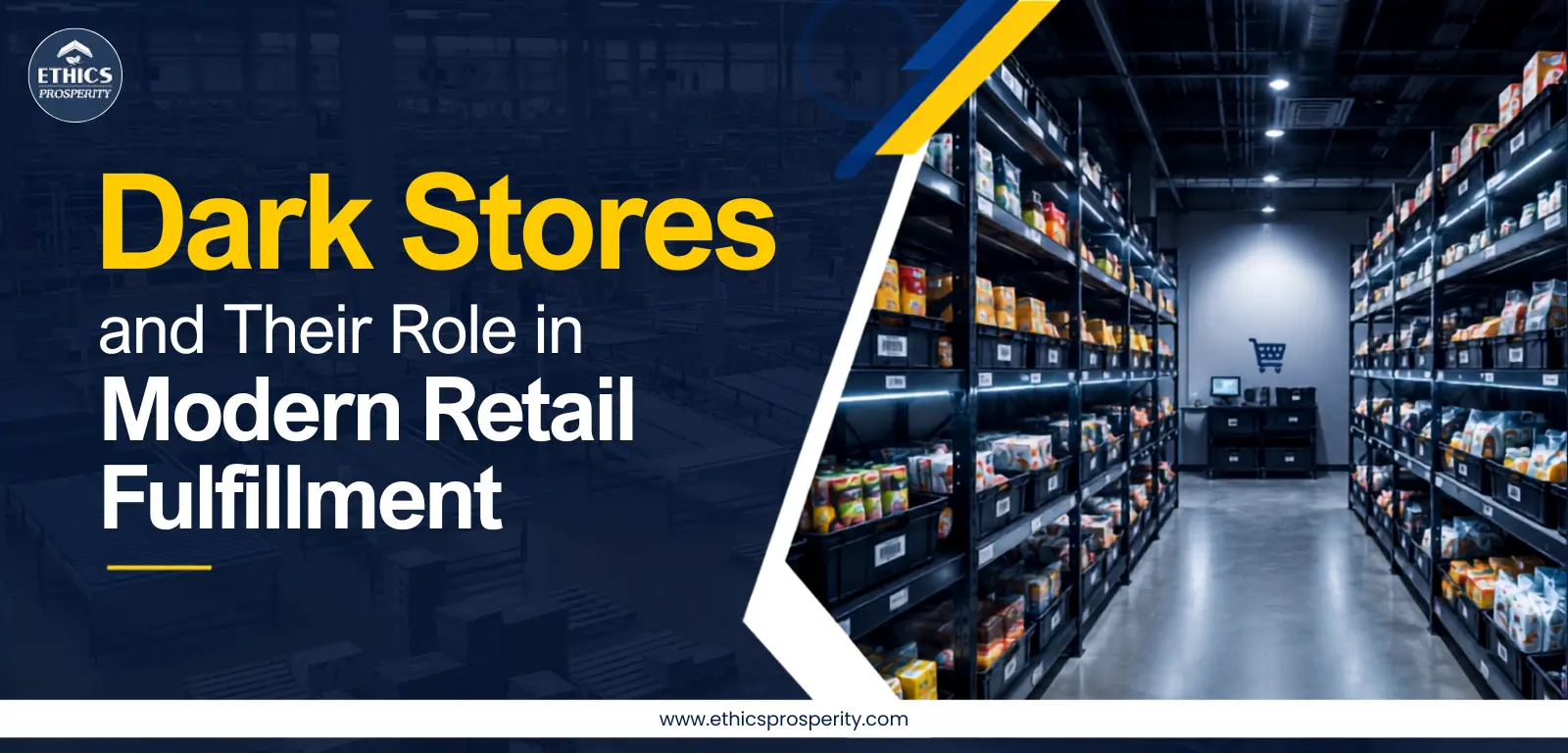
Unlike conventional retail outlets, a dark store is designed primarily for order preparation and fulfillment rather than walk-in shopping. Products are stored, picked, packed, and dispatched from a location positioned close to the customers it serves.
The model has gained particular relevance in e-commerce and quick-commerce operations, where delivery speed and inventory availability directly influence customer experience.
However, a dark store is not simply a smaller warehouse. Its economics, SKU strategy, operating processes, technology requirements, and location decisions are closely connected to the customer delivery promise.
What Is a Dark Store and How Does a Dark Store Work?
A dark store is a retail or fulfillment facility that is closed to conventional shoppers and dedicated primarily to fulfilling online orders.
The basic operating cycle is straightforward:
Inventory receiving → Put-away → Order allocation → Picking → Quality check → Packing → Dispatch → Last-mile delivery
The difference lies in the operating priorities.
A conventional retail store must balance customer-facing activities, merchandising, store operations, and inventory. A dark store can instead organize its layout around picking speed, inventory accessibility, order accuracy, and dispatch efficiency.
A typical facility may use defined storage zones for fast-moving products, temperature-sensitive items, household products, personal care products, and other SKU categories.
Location is equally important.
A dark store is generally positioned within or close to a high-demand customer catchment. The objective is not simply to minimize warehouse rent; it is to create an economically viable balance between inventory availability, picking productivity, delivery distance, and order density.
For retailers, this makes dark stores a network-design decision rather than merely a property decision.
Key Benefits of Dark Stores for Retailers
Faster Order Fulfillment
A dedicated fulfillment environment removes many activities associated with traditional retail stores.
Pickers can follow optimized routes, products can be arranged according to demand velocity, and packing stations can be designed specifically around online orders.
The result can be shorter order-processing cycles, particularly when order volumes are predictable and the SKU range is appropriately designed.
Better Inventory Positioning
Inventory closer to customers can reduce delivery distances and improve responsiveness.
For retailers operating across multiple urban markets, positioning fast-moving products in localized facilities can help support service-level commitments without relying entirely on a single large regional warehouse.
This approach can become an important component of broader Supply chain management strategies.
Improved Last-Mile Economics
Last-mile delivery is often one of the most expensive and operationally complex parts of retail distribution.
A strategically positioned dark store can reduce average delivery distance and improve route density.
However, the benefit depends on order concentration. A poorly located dark store with insufficient demand can create additional fixed costs without generating enough delivery efficiency.
Greater Operational Flexibility
Dark stores can be designed around specific customer and product requirements.
Retailers can configure storage areas, picking paths, packing stations, replenishment processes, and dispatch zones without having to accommodate traditional shopping behavior.
Dark Stores vs Traditional Retail Stores vs Warehouses
Although these facilities may share some physical characteristics, their operating objectives are different.
|
Factor |
Dark Store |
Traditional Retail Store |
Conventional Warehouse |
|
Primary purpose |
Online order fulfillment |
Customer shopping |
Storage and distribution |
|
Customer access |
Generally closed to shoppers |
Open |
Closed |
|
Inventory |
Customer-demand focused |
Retail assortment |
Often broader inventory |
|
Picking |
High-frequency |
Limited/assisted |
Batch or wave-based |
|
Location |
Close to demand |
High-footfall areas |
Strategic logistics corridors |
|
Order cycle |
Short |
Store purchase |
Variable |
|
Last-mile role |
Directly supports delivery |
Usually secondary |
Often regional/distribution role |
A conventional warehouse is typically designed for inventory storage and distribution at a larger network level.
A dark store is designed around rapid customer-order fulfillment.
The distinction becomes especially important when evaluating End-to-end supply chain design. A retailer may need regional distribution centers, conventional warehouses, dark stores, transportation hubs, and delivery operations to work together rather than treating one facility type as a replacement for another.
Challenges of the Dark Store Model
Dark stores can improve fulfillment performance, but they also introduce operational and financial challenges.
Location and Real-Estate Costs
Being close to customers is one of the model's biggest advantages—and one of its largest costs.
Urban or near-urban locations can command higher rents. Businesses therefore need sufficient order density to justify the additional facility cost.
Inventory Accuracy
A dark store operates with high transaction frequency. Even a small inventory discrepancy can cause substitutions, cancellations, delayed orders, or customer dissatisfaction.
Strong receiving, cycle counting, stock reconciliation, and replenishment controls are therefore essential.
SKU Selection
More SKUs do not automatically mean better customer service.
Excessive assortment can increase inventory holding costs, reduce picking efficiency, and create slow-moving stock.
Retailers need to identify which products genuinely justify local stocking.
Labor Productivity
Fast fulfillment requires disciplined processes.
Picking routes, shift planning, replenishment timing, packing productivity, worker safety, and peak-hour staffing all affect unit economics.
Network Complexity
Adding multiple dark stores can create another layer of inventory and replenishment complexity.
Retailers must determine which products should be stocked locally, where replenishment should originate, and how inventory should move between facilities.
How Technology Is Transforming Dark Store Operations
Technology is increasingly central to dark store performance.
A Warehouse Management System can coordinate receiving, inventory locations, picking, packing, and dispatch while providing operational visibility.
Real-time inventory information is particularly important because customers expect product availability information to reflect actual stock.
Data can also support better replenishment decisions.
Demand patterns can be analyzed by location, time, product category, season, and customer behavior. This helps businesses position inventory closer to actual demand instead of relying entirely on historical averages.
Automation can also be introduced where the economics make sense.
For high-volume operations, technologies such as pick-to-light systems, conveyors, automated storage solutions, handheld scanning, and robotics can reduce manual movement and improve throughput.
AI can support demand forecasting, replenishment recommendations, slotting decisions, and anomaly detection. IoT-enabled devices can also provide information about equipment, environmental conditions, and operational assets.
The objective should not be to automate everything.
The better approach is to identify the operational bottlenecks where technology can produce measurable improvements in productivity, accuracy, safety, or service levels.
The Role of Dark Stores in Modern Retail Networks
The rise of dark stores should not be viewed as the replacement of traditional warehouses.
Instead, they can form one layer within a broader retail fulfillment network.
A large retailer may use:
Supplier → Regional Distribution Center → Local Warehouse/Dark Store → Delivery Network → Customer
This model allows inventory to be positioned at different stages based on demand and service requirements.
For organizations working with warehousing and logistics, the key challenge is coordinating these nodes effectively.
The same principle applies to storage and fulfillment services. Storage capacity alone does not create fulfillment performance; inventory positioning, order processing, transportation, and technology must work together.
Dark Stores and the E-Commerce Fulfillment Model
The growth of online retail has increased the need for fulfillment models that can support different customer expectations.
Traditional e-commerce may tolerate delivery windows of one or several days depending on the product category.
Quick commerce typically operates with much tighter delivery expectations and therefore requires a denser local fulfillment network.
This is where E-commerce fulfillment companies and specialized retail operators increasingly need to distinguish between network models rather than applying one fulfillment strategy to every category.
The discussion around e-commerce vs quick commerce fulfillment is therefore not simply about delivery speed.
It also involves:
-
Inventory depth
-
SKU selection
-
Order density
-
Facility location
-
Picking productivity
-
Replenishment frequency
-
Delivery economics
The Future of Dark Stores in Retail Fulfillment
Dark stores are likely to remain relevant where customer density, order frequency, and delivery expectations support the economics.
However, the future model is likely to be more selective.
Retailers will increasingly assess whether a dark store is justified by measurable demand rather than adopting the model simply because competitors are doing so.
The next stage of development is likely to involve greater integration between demand forecasting, inventory positioning, warehouse technology, transportation planning, and delivery operations.
This could lead to more sophisticated micro fulfillment networks in high-demand urban markets.
At the same time, traditional warehouses will continue to play a critical role in regional inventory consolidation and replenishment.
The result will be a more layered fulfillment network rather than a single dominant facility model.
Conclusion
Dark stores have become an important tool for retailers seeking to bring inventory closer to customers and improve online order fulfillment.
But their success depends on disciplined network planning. Location, order density, SKU selection, inventory accuracy, labor productivity, technology, replenishment, and last-mile economics must all work together.
For supply chain companies evaluating the model, the key question should not be whether dark stores are “better” than warehouses or retail stores. The more useful question is where a dark store creates measurable operational and customer-service value within the wider network.
As retail fulfillment continues to evolve, businesses that combine data-driven inventory decisions, appropriate facility formats, and efficient fulfillment processes will be better positioned to respond to changing customer expectations.