Last-mile delivery has become one of the most operationally demanding stages of the logistics process. The growth of e-commerce, quick commerce, food delivery and direct-to-consumer businesses has increased the number of daily deliveries, shortened customer expectations and placed greater pressure on urban transportation networks.
At the same time, businesses are facing rising fuel costs, traffic congestion and growing expectations to reduce the environmental impact of their operations. These pressures are encouraging logistics operators to reconsider how goods move from distribution centres and fulfilment hubs to customers.
Electric vehicles (EVs) are emerging as a practical option for suitable delivery routes. When supported by charging infrastructure, effective route planning and the right fleet model, they can help businesses improve delivery economics while reducing tailpipe emissions.
This shift is an important part of green logistics. However, adopting electric vehicles is not simply a matter of replacing petrol or diesel vehicles. It requires careful planning around routes, vehicle capacity, charging schedules, operating costs and delivery commitments.
What Is Green Logistics?
Green logistics refers to the planning and execution of transportation, warehousing, packaging and distribution activities in ways that reduce environmental impact while maintaining operational and commercial performance.
It focuses on making logistics operations more resource-efficient. This may include reducing fuel consumption, improving vehicle utilisation, selecting lower-emission transportation options, optimising delivery routes and reducing unnecessary packaging or product movement.
For businesses, sustainability initiatives must also make operational sense. A transportation model that reduces emissions but increases delivery failures, vehicle downtime or cost per shipment may not be commercially viable.
This is why green initiatives should be integrated into broader Supply chain management decisions rather than treated as a separate environmental activity.
Common green logistics initiatives include:
-
Introducing electric vehicles for suitable delivery routes.
-
Consolidating shipments to reduce partially loaded trips.
-
Improving route planning to avoid unnecessary kilometres.
-
Using energy-efficient warehouses and material-handling equipment.
-
Monitoring fuel consumption and vehicle performance.
-
Improving packaging design to reduce material usage and transport volume.
The objective is to build logistics operations that balance service quality, cost efficiency and environmental responsibility.
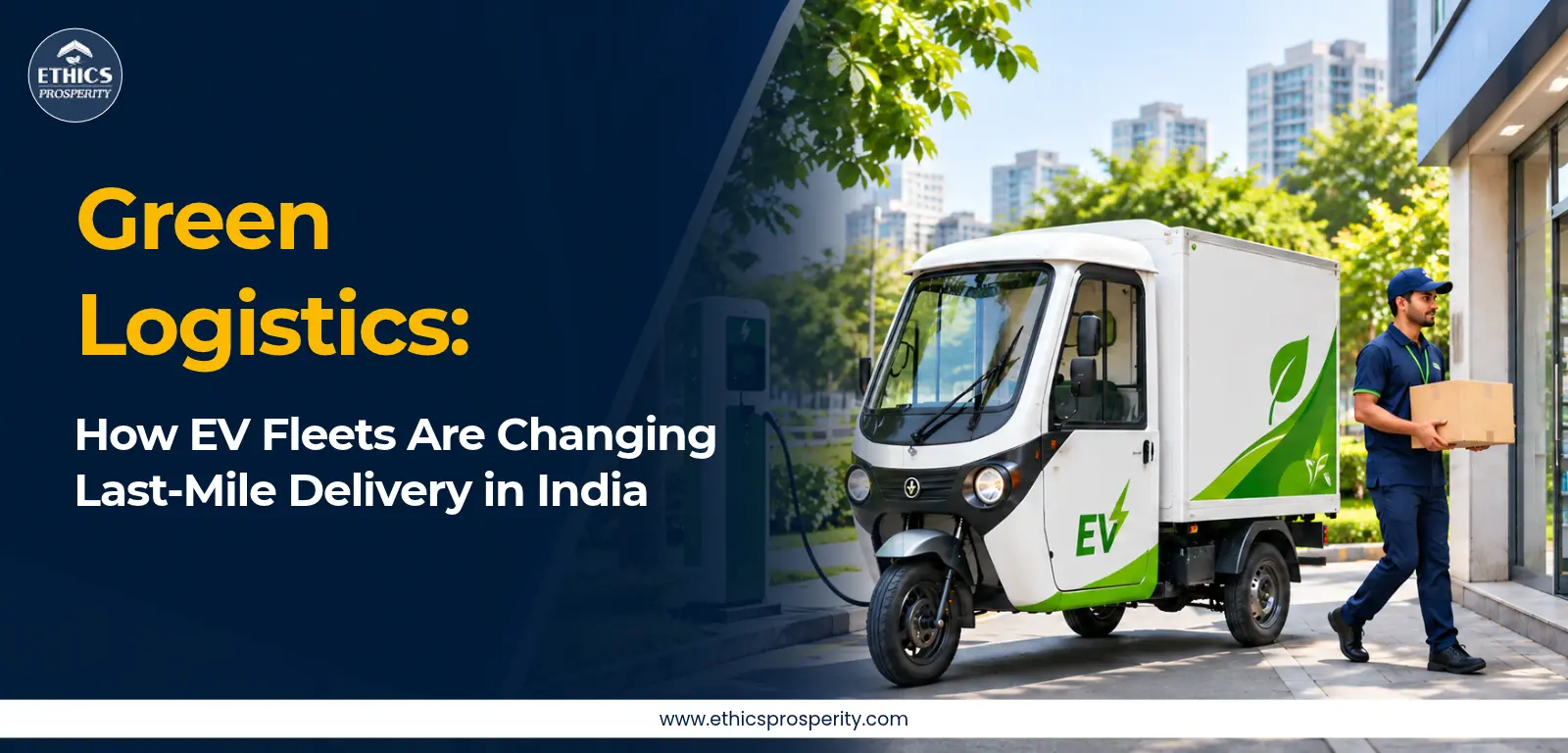
How EV Fleets Are Transforming Last-Mile Delivery in India
Last-mile delivery typically involves frequent stops, shorter travel distances and movement through congested urban areas. These operating conditions can make electric two-wheelers, three-wheelers and selected light commercial vehicles suitable for specific delivery applications.
E-commerce companies, grocery platforms, retailers and third-party logistics providers are evaluating EVs for routes where daily distance, payload and charging access can be planned reliably.
Electric vehicles for different delivery requirements
The right vehicle depends on the shipment profile and service area.
|
Vehicle type |
Potential logistics application |
|
Electric two-wheelers |
Small parcels, documents and individual customer deliveries |
|
Electric three-wheelers |
Grocery orders, consolidated parcels and neighbourhood distribution |
|
Electric light commercial vehicles |
Larger consignments and scheduled urban deliveries |
A business should not select a vehicle only on the basis of purchase price or advertised range. Payload capacity, actual range under operating conditions, charging time, service support and vehicle availability all affect performance.
Why Indian businesses are considering EV adoption
India's dense urban markets create opportunities for electric delivery fleets, particularly where vehicles operate on predictable routes and return to a hub or charging location.
A useful indication of growing interest came from Flipkart's March 2026 announcement. Its survey of more than 6,000 delivery partners reported that nearly 46% were interested in transitioning to electric mobility. The company also identified vehicle cost, charging access, model availability and confidence in EV performance as adoption challenges.
Flipkart Stories
This highlights an important point for fleet operators: interest in EVs is growing, but successful adoption depends on solving practical operating constraints.
Key Benefits of EV Fleets in Logistics
Electric vehicles can offer several operational and environmental advantages. The actual benefit depends on vehicle utilisation, electricity costs, maintenance arrangements, route conditions and the source of electricity.
1. Potential reduction in operating costs
Electric vehicles can reduce expenditure on conventional fuel. They also have fewer moving parts in some drivetrain components, which may reduce certain maintenance requirements.
However, businesses should compare the total cost of ownership rather than looking only at fuel savings. The calculation should include vehicle acquisition or lease cost, battery-related expenses, charging equipment, electricity tariffs, insurance, maintenance, financing and downtime.
2. Lower tailpipe emissions
EVs do not produce tailpipe emissions while driving. This can help reduce local air pollutants in densely populated delivery areas.
The overall environmental benefit also depends on how electricity is generated, battery production and battery end-of-life management. Businesses should therefore avoid presenting EV adoption as completely emission-free across the entire lifecycle.
3. Better suitability for urban delivery routes
Electric two-wheelers and three-wheelers can be useful for short-distance routes with frequent stops. They may help businesses manage neighbourhood deliveries where vehicle size, parking and traffic conditions affect productivity.
4. Support for sustainability commitments
Retailers and manufacturers increasingly assess the environmental performance of their distribution partners. Integrating EVs into suitable routes can support measurable sustainability programmes and improve the quality of emissions reporting.
For operators managing an End-to-end supply chain, vehicle electrification can form one part of a wider plan covering transportation, warehousing, packaging and distribution.
Challenges of EV Adoption in Last-Mile Delivery
Despite their potential, electric fleets are not suitable for every route or delivery requirement. Businesses must assess the following challenges before making large-scale investments.
1. Initial investment and financing
The upfront cost of an electric vehicle, charging equipment and supporting infrastructure can be a barrier, especially for small fleet operators and delivery partners.
Leasing, vehicle subscription models, financing arrangements and phased procurement can help reduce the initial capital burden.
2. Charging infrastructure and vehicle downtime
Charging access is a major operational consideration. If vehicles cannot charge at the right location or time, delivery schedules may be affected.
Businesses should assess whether charging is available at warehouses, fulfilment centres, delivery hubs or partner locations. They should also plan charging slots around shift timings and vehicle deployment.
3. Range and payload limitations
A vehicle's advertised range may differ from its real-world performance. Payload, road conditions, traffic, weather, driving behaviour and battery condition can influence the distance covered.
Fleet managers should test vehicles on actual delivery routes before finalising procurement.
4. Service network and battery management
Vehicle downtime can affect customer commitments and fleet utilisation. Businesses need access to reliable servicing, spare parts, battery support and clear warranty terms.
Battery health monitoring and end-of-life handling should also be included in the fleet policy.
5. Different requirements across locations
A fleet model that works in a compact urban delivery zone may not be appropriate for longer intercity routes. Logistics companies in India must evaluate vehicle suitability according to local infrastructure, route density, shipment profile and service expectations.
Role of Technology in EV Fleet Management
Technology helps businesses manage the operational complexity of electric fleets. Without reliable data, fleet managers may struggle to identify underutilised vehicles, inefficient routes or charging-related delays.
Fleet tracking and telematics
GPS tracking and telematics can provide information about vehicle location, distance travelled, speed, idle time and route performance. Managers can use this data to monitor service levels and identify operational inefficiencies.
Route optimisation
Route-planning systems can consider delivery locations, traffic conditions, vehicle capacity, delivery time windows and charging requirements. This helps reduce unnecessary kilometres and improves vehicle utilisation.
Battery and charging management
Battery monitoring tools can help track charge levels, battery health and charging patterns. Fleet managers can schedule charging during suitable periods and reduce the risk of vehicles becoming unavailable during peak delivery hours.
Data-led fleet decisions
AI in logistics can support demand forecasting, route recommendations, vehicle allocation and predictive maintenance when the underlying data is accurate and systems are properly integrated.
Technology should support operational decisions, not replace them. Managers still need to validate recommendations against delivery commitments, vehicle limitations and local conditions.
Best Practices for Implementing EV Fleets
A phased implementation is generally more practical than converting an entire fleet at once.
1. Start with a route and shipment assessment
Identify routes with predictable daily distances, frequent delivery stops and manageable payload requirements. These are often better candidates for an initial EV deployment.
2. Run a controlled pilot
Select a limited number of vehicles and monitor them across normal operating conditions. Include peak periods, different payloads and real traffic conditions.
Record delivery completion, charging time, vehicle availability, maintenance events and cost per delivery.
3. Calculate total cost of ownership
Compare electric and conventional vehicles over an appropriate operating period. Include acquisition, financing, energy, maintenance, insurance, battery-related costs and downtime.
This provides a more reliable basis for investment decisions than comparing fuel and electricity costs alone.
4. Align charging with warehouse operations
Charging plans should be linked to vehicle dispatch and return schedules. Businesses should assess electricity capacity, charger availability, parking arrangements and the time required to prepare vehicles for the next shift.
The relationship between logistics and warehouse operations is particularly important because vehicle charging, loading and dispatch may compete for the same space and operating windows.
5. Work with reliable fleet and infrastructure partners
Evaluate vehicle manufacturers, leasing providers, charging operators and maintenance partners on service coverage, response time, spare-part availability and contractual terms.
When reviewing supply chain companies or logistics partners, businesses should ask for measurable information about fleet performance and sustainability practices rather than relying only on broad environmental claims.
6. Track performance using clear KPIs
Monitor cost per kilometre, cost per delivery, vehicle utilisation, on-time delivery, charging downtime, energy consumption and maintenance costs.
A pilot should be expanded only when the data demonstrates that the fleet can meet service and commercial requirements.
Future of Green Logistics in India
The future of green logistics in India will depend on more than vehicle availability. Charging infrastructure, financing, battery technology, electricity access, service networks and fleet-management capabilities will influence the pace of adoption.
Businesses are also likely to use a mix of vehicle types rather than relying on a single transportation model. Electric two-wheelers and three-wheelers may serve dense urban routes, while other vehicle categories may remain more suitable for longer distances or heavier loads.
For warehouse operators and businesses researching the top 10 warehousing companies in gurugram, sustainability performance is one factor worth evaluating alongside location, capacity, technology, service quality and distribution connectivity.
Over time, better route data, connected fleet systems and improved charging access could make EV deployment more predictable. AI in logistics may also help operators coordinate demand, vehicle availability and delivery schedules more efficiently.
The most practical approach is to scale based on evidence: begin with suitable routes, measure actual performance and expand where the operational and financial case is strong.
Conclusion
Electric vehicles are creating new opportunities to make last-mile delivery cleaner and more efficient. However, successful adoption requires more than replacing conventional vehicles. Businesses must evaluate route suitability, payload requirements, charging infrastructure, total cost of ownership and fleet reliability before making investment decisions.
A phased approach supported by accurate performance data can help organisations reduce implementation risks while building more sustainable distribution operations. As businesses work towards more efficient and responsible logistics networks, Ethics Prosperity recognises the importance of combining operational planning, technology and sustainable transportation to support evolving supply chain requirements.
Current-industry context: The 2026 examples above are based on publicly announced developments, including Flipkart's March 2026 delivery-partner survey. The article avoids unsupported claims about nationwide EV penetration or guaranteed cost savings.