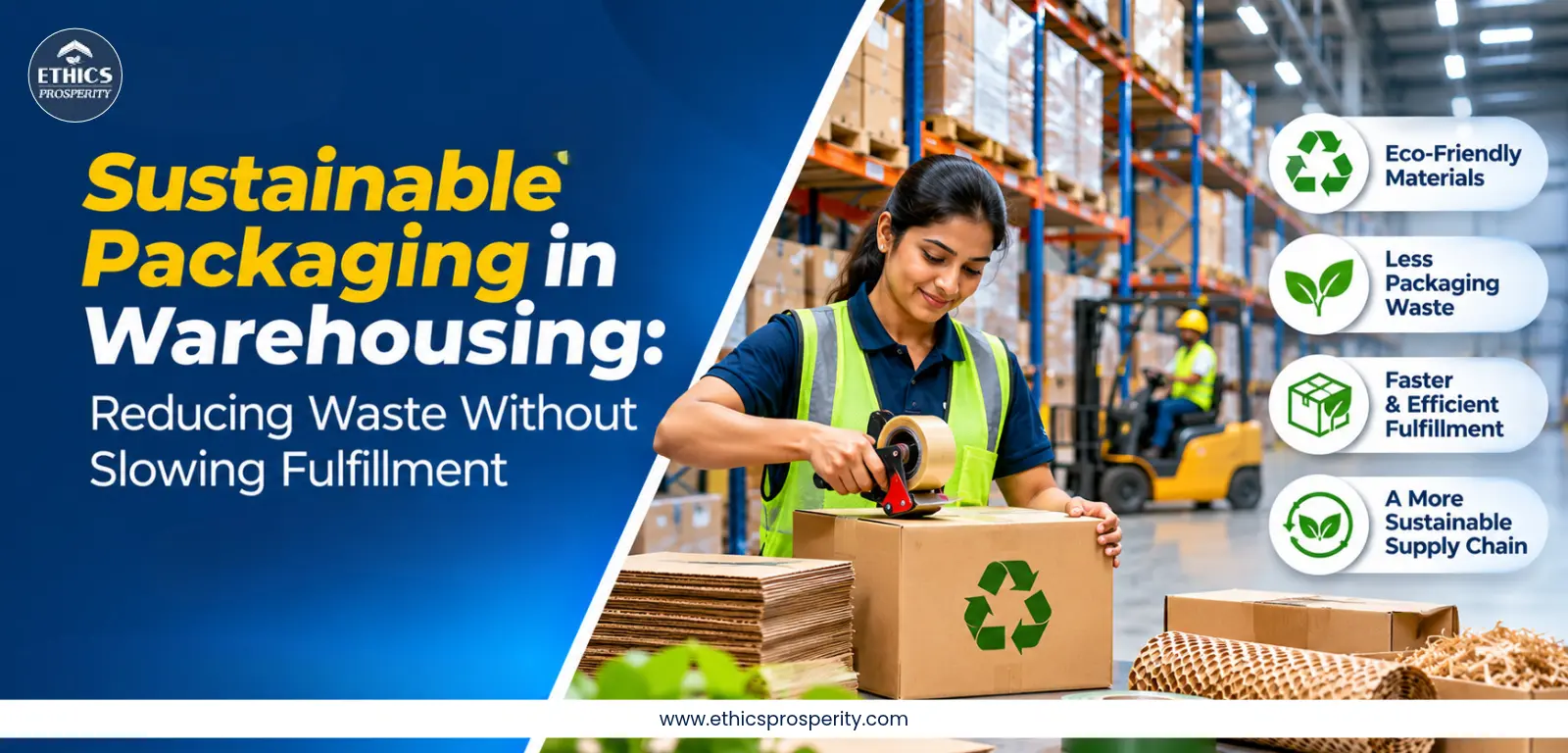
Packaging plays an important role in warehouse operations. It protects products during storage, picking, packing, handling and transportation. However, oversized cartons, excessive fillers, single-use materials and inconsistent packing practices can increase material consumption, waste disposal requirements and operating costs.
For businesses managing high order volumes, packaging decisions have a direct impact on warehouse productivity and distribution performance. The challenge is not simply to replace conventional materials with environmentally preferable alternatives. It is to reduce unnecessary packaging while ensuring that products remain protected and orders move through the warehouse on schedule.
Sustainable packaging in warehousing is therefore an operational improvement opportunity. With the right material selection, packaging standards, workforce practices and technology, businesses can reduce waste without creating additional handling time or fulfilment delays.
What Is Sustainable Packaging in Warehousing?
Sustainable packaging in warehousing means selecting, using and managing packaging materials in a way that reduces unnecessary resource consumption and waste while meeting product protection, storage and transportation requirements.
It considers the complete packaging process—not just the material used for the final parcel. This includes inbound packaging received from suppliers, protective materials used during storage, cartons and fillers used for dispatch, and packaging waste generated during daily warehouse activities.
A practical approach considers three priorities:
-
Product protection: Packaging must prevent damage during handling, stacking and transportation.
-
Material efficiency: The quantity and type of packaging should match the product's actual requirements.
-
Operational performance: Packing methods should support consistent processing times and dispatch schedules.
For organisations focused on warehouse sustainability, the objective is to balance environmental considerations with product safety, labour productivity and total operating cost.
Common Sources of Packaging Waste in Warehouses
Packaging waste often develops through routine processes rather than a single major operational issue. Identifying where materials are being consumed unnecessarily is the first step towards improvement.
Common sources include:
-
Oversized cartons: Using a large box for a small product increases void space and often requires additional protective filler.
-
Excessive protective materials: Multiple layers of bubble wrap, paper or plastic may be used when a simpler solution would provide sufficient protection.
-
Single-use packaging: Materials that cannot be reused or recovered through available waste-management channels contribute to disposal volumes.
-
Supplier packaging: Inbound goods may arrive in unnecessary layers of wrapping, cartons or plastic that are removed before storage.
-
Incorrect packing practices: Inconsistent decisions by packing teams can lead to different material usage for similar products.
-
Product damage and returns: Poor packaging can cause breakage, leakage or other damage, resulting in replacement shipments and additional packaging consumption.
These issues can be particularly visible in high-volume operations where order fulfillment efficiency depends on predictable packing processes and minimal rework.
Practical Ways to Reduce Packaging Waste
Reducing packaging waste requires process changes that warehouse teams can follow consistently. Businesses should begin with the areas where material consumption is highest and where improvements can be introduced without compromising product protection.
Right-Size Packaging for Each Order
Carton selection should be based on product dimensions, weight, fragility and the number of items in an order. A carton that is too large increases material use and may require more void fill. A carton that is too small can increase the risk of product damage.
Businesses can introduce a defined range of carton sizes and packing guidelines for common product categories. For multi-item orders, packaging teams should consider product compatibility and the most space-efficient arrangement.
Select Materials Based on Product Requirements
Not every product requires the same packaging material. Fragile electronics, apparel, industrial components and temperature-sensitive goods have different protection requirements.
Businesses can evaluate eco-friendly packaging solutions such as recycled-content cartons, paper-based protective materials and reusable transit packaging where these are suitable for the product and distribution route.
Material selection should consider strength, moisture exposure, stacking conditions, handling frequency and the availability of appropriate recycling or recovery facilities. A material should not be selected solely because it carries a sustainability label.
Reuse Suitable Packaging Materials
Reusable packaging can be effective in operations with predictable, repeatable movement between facilities, suppliers and distribution points.
Examples include reusable crates, totes, pallets and returnable containers. These can reduce the need for disposable packaging when collection, inspection, cleaning and redistribution are properly managed.
Before introducing a reusable system, businesses should assess return rates, reverse movement costs, storage requirements and the risk of loss or damage. Reuse is most effective when the operating model supports repeated circulation.
Standardise Packaging Procedures
Written packing guidelines help reduce unnecessary material consumption and improve consistency across shifts and locations.
A standard operating procedure should define:
-
Approved carton sizes and material types.
-
Packing methods for different product categories.
-
Minimum protection requirements.
-
Rules for reusing inbound packaging.
-
Material segregation and disposal procedures.
Regular training and spot checks can help ensure that these procedures are followed in daily operations.
How to Maintain Fast Order Fulfillment with Sustainable Packaging
Sustainable packaging should support warehouse performance rather than create a separate, slower process. This is particularly important for e-commerce, retail replenishment and business-to-business distribution, where dispatch commitments and delivery schedules influence customer satisfaction.
A well-designed packaging optimization programme can improve material usage while maintaining packing speed.
Businesses can protect throughput by taking the following steps:
-
Keep frequently used materials within reach: Position cartons, tapes and protective materials near packing stations to reduce unnecessary movement.
-
Create product-based packing instructions: Use simple visual guides for common product categories so employees do not need to make repeated decisions.
-
Use pre-approved packaging combinations: Standard carton and filler combinations can reduce trial-and-error during busy periods.
-
Test changes before large-scale implementation: Pilot new materials on selected products and routes before introducing them across the warehouse.
-
Monitor packing time and damage together: A faster packing process is not an improvement if it increases transit damage or customer complaints.
The broader End-to-end supply chain should also be considered. Packaging decisions made at the warehouse can affect pallet utilisation, vehicle space, handling requirements and the condition in which products reach customers.
Role of Technology in Sustainable Warehouse Packaging
Technology can help warehouses identify material waste, standardise packing decisions and monitor performance. It is most useful when connected to actual operating data and supported by practical workflows.
A warehouse management system can provide order, SKU and inventory information that helps packing teams select suitable packaging. When product dimensions and packaging rules are maintained accurately, the system can support more consistent carton selection.
Other useful applications include:
-
Dimensioning systems: Capture product or parcel dimensions to support carton selection and reduce avoidable empty space.
-
Barcode scanning: Confirm products and quantities before packing, helping prevent errors and repacking.
-
Packaging analytics: Track material consumption, packaging costs and waste by product, order type or warehouse.
-
Digital work instructions: Display packing guidance at workstations to support standard processes.
-
Inventory monitoring: Maintain visibility of packaging material stock to avoid emergency purchases and uncontrolled substitutions.
For businesses investing in Supply chain management, packaging data can become part of wider operational reporting, helping procurement, warehouse and distribution teams make better-informed decisions.
Benefits of Sustainable Packaging for Businesses
A structured packaging improvement programme can deliver operational and commercial benefits when it is designed around measurable business requirements.
Lower material consumption: Right-sized cartons and controlled use of fillers can reduce the quantity of packaging purchased and consumed.
Better space utilisation: Appropriate carton selection can reduce unnecessary parcel volume. Depending on the shipment profile, this may support better pallet and vehicle utilisation.
Improved cost control: Reduced material usage, lower disposal volumes and fewer damage-related replacements can contribute to cost savings.
More consistent warehouse processes: Standardised packaging rules reduce variation between employees, shifts and facilities.
Stronger customer experience: Packaging that protects products without excessive material can support a cleaner, more practical delivery experience.
For supply chain companies, these improvements can also support wider Green Logistics initiatives when packaging changes are connected with transport, storage and waste-management practices.
Challenges in Implementing Sustainable Packaging
Moving towards sustainable packaging requires planning. A material that works well for one product or route may not be suitable for another.
Common implementation challenges include:
-
Higher initial material costs: Some alternative materials may have a higher purchase price. Businesses should compare total cost per shipment rather than purchase price alone.
-
Product compatibility: Packaging must withstand the actual handling, storage and transport conditions.
-
Supplier limitations: Material availability, quality consistency and delivery lead times can affect implementation.
-
Employee adoption: Teams may continue using familiar methods unless new procedures are clear and practical.
-
Recycling infrastructure: A material described as recyclable may not be accepted by local collection or processing facilities.
-
Performance trade-offs: Reducing material too aggressively can increase product damage, returns and replacement costs.
Businesses should assess suppliers and warehousing companies in India on measurable operational capabilities, including packaging standards, material traceability, waste segregation and the ability to report performance. Any sustainability claims should be supported by evidence rather than broad labels.
KPIs to Measure Sustainable Packaging Performance
A packaging initiative should be evaluated through a combination of environmental, operational and financial indicators. Measuring only the quantity of material purchased may hide problems such as higher damage rates or slower packing.
|
KPI |
What it measures |
Why it matters |
|
Packaging material per order |
Average packaging consumed for each shipment |
Tracks material efficiency |
|
Packaging cost per order |
Total packaging cost divided by orders processed |
Measures cost impact |
|
Packaging waste generated |
Quantity of packaging waste over a defined period |
Tracks waste reduction |
|
Packaging reuse rate |
Share of suitable packaging reused |
Measures reuse performance |
|
Product damage rate |
Share of orders damaged during handling or transit |
Checks whether protection is adequate |
|
Average packing time |
Time taken to pack an order |
Monitors fulfilment speed |
|
Carton utilisation |
How effectively carton space is used |
Identifies excessive empty space |
Establish a baseline before making changes. Compare performance across similar product categories, order profiles and operating periods. For example, a change in average packing time should be assessed alongside order complexity and volume so that the result is not misinterpreted.
A balanced scorecard helps management determine whether packaging changes are genuinely improving warehouse performance.
Conclusion
Sustainable packaging is most effective when it is treated as part of warehouse process improvement—not simply as a material replacement exercise. Businesses should identify waste at each stage, select packaging according to product and route requirements, standardise packing procedures and use operational data to measure results.
The right approach can help reduce material consumption while protecting products, maintaining dispatch commitments and controlling costs. For businesses reviewing their warehousing and distribution operations, Ethics Prosperity can be considered as a partner for discussing practical supply chain requirements and operational improvement opportunities.