For many businesses, the customer journey appears simple: a customer places an order, the company processes it, the warehouse picks and packs it, and the shipment reaches its destination.
Operationally, it is rarely that simple.
An order can involve multiple warehouses, sales channels, inventory locations, transportation partners, payment systems and delivery commitments. When these functions operate in disconnected systems, the result is often poor inventory visibility, delayed processing, manual intervention and avoidable customer-service issues.
This is where Order Management Systems become strategically important.
An OMS creates a central layer for managing orders across their lifecycle. It connects commercial demand with available inventory, fulfillment capacity and delivery execution, helping businesses make better decisions about where, when and how an order should be fulfilled.
For B2B organizations handling large order volumes, multiple locations or complex fulfillment requirements, this capability can directly influence service levels, working capital and operating efficiency.
What Is an Order Management System (OMS)?
An Order Management System is a technology platform that captures, validates, manages and coordinates customer orders from the point of order creation through fulfillment, shipment and, where applicable, returns or cancellations.
An OMS does not simply record an order.
Its real value comes from coordinating the decisions surrounding that order.
For example, when an order arrives, the system may need to determine:
-
Is the requested stock actually available?
-
Which facility should fulfill it?
-
Can the committed delivery date be achieved?
-
Should the order be split across locations?
-
Which transportation option is appropriate?
-
What happens if the preferred inventory location cannot fulfill it?
-
How should an exception be escalated?
These decisions become increasingly important as businesses expand across regions, sales channels and fulfillment locations.
What an OMS Actually Controls
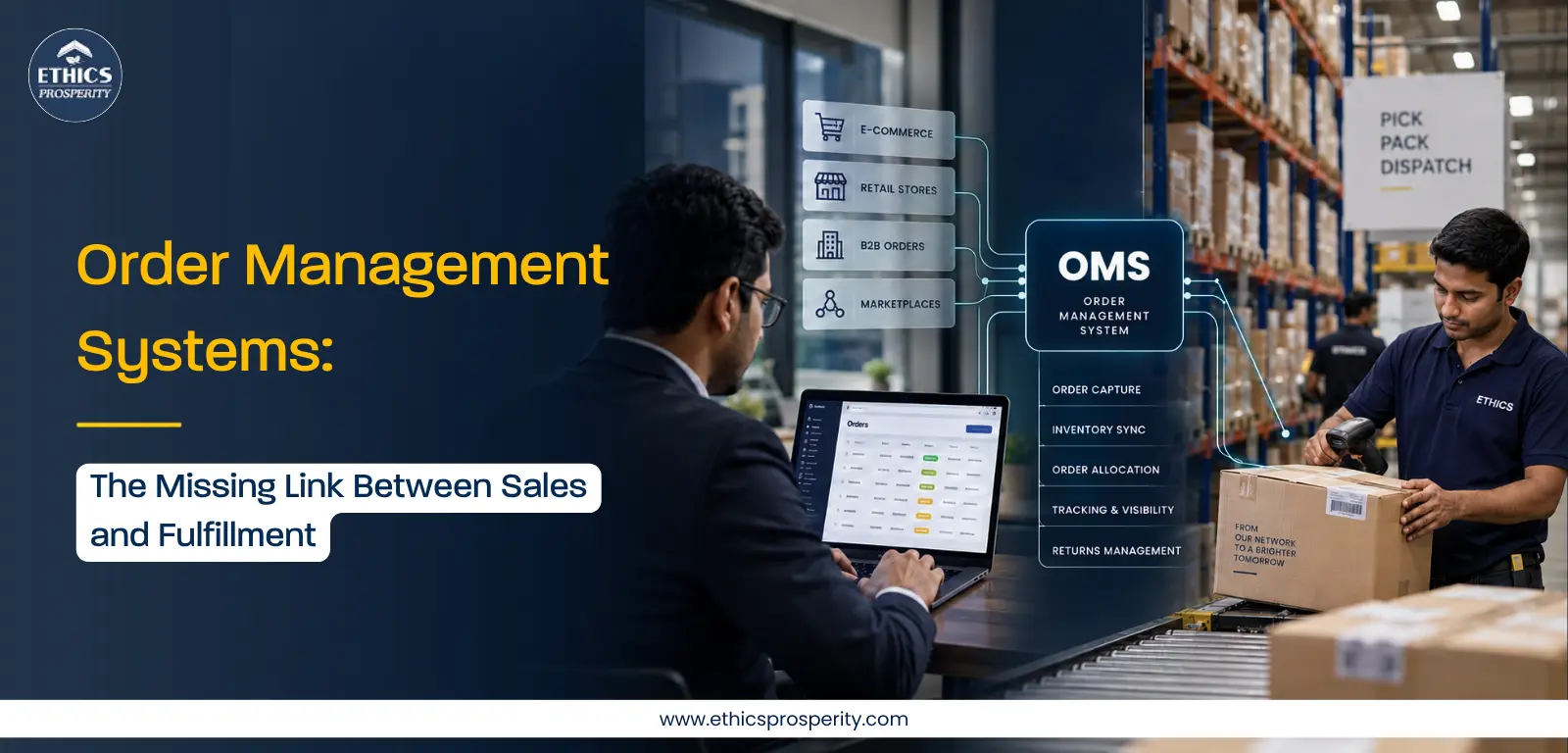
A capable OMS can provide visibility across:
-
Order capture
-
Order validation
-
Inventory availability
-
Allocation
-
Fulfillment routing
-
Shipment status
-
Order changes
-
Cancellations
-
Returns
-
Exceptions
-
Customer notifications
The objective is not to replace every system in the organization. Instead, the OMS acts as an orchestration layer connecting order demand with downstream execution.
Why Order Visibility Matters to B2B Operations
In B2B commerce, an order may contain multiple SKUs, delivery locations, service-level requirements and commercial conditions.
A delayed order is therefore not simply a delayed parcel. It can affect production schedules, retail availability, distributor commitments and customer relationships.
Strong order visibility allows operations teams to identify issues earlier instead of discovering them after a delivery commitment has already been missed.
How Does an Order Management System Work?
The exact architecture varies by business, but the operational journey generally follows a similar pattern.
1. Order Capture and Validation
Orders can originate from websites, marketplaces, sales teams, EDI connections, dealer networks or other business applications.
The OMS receives the order and checks essential information such as product details, quantities, delivery location and commercial rules.
Errors identified at this stage are easier and cheaper to resolve than errors discovered after picking or dispatch.
2. Inventory Availability and Allocation
The OMS evaluates inventory across relevant fulfillment locations.
This is different from simply asking whether a product exists in the system.
Operational availability may depend on:
-
Physical stock
-
Reserved inventory
-
Damaged or blocked stock
-
Safety stock
-
Location-specific inventory
-
Customer commitments
-
Expected replenishment
-
Cut-off times
This makes the connection between orders and inventory management particularly important.
3. Order Routing and Fulfillment
Once inventory is evaluated, the OMS can determine the most suitable fulfillment location based on business rules.
The objective may be to minimize transportation cost, protect delivery timelines, reduce split shipments or balance warehouse capacity.
For example, a national B2B distributor may receive an order from a customer in southern India. If inventory is available in multiple facilities, the best fulfillment location may not simply be the warehouse holding the largest quantity.
Transportation cost, service commitment, stock position and operational capacity may all influence the decision.
4. Shipment Tracking and Exception Management
After fulfillment begins, the OMS can consolidate order status information from downstream systems.
This creates greater visibility into whether an order is:
-
Confirmed
-
Allocated
-
Picked
-
Packed
-
Dispatched
-
In transit
-
Delivered
-
Delayed
-
Cancelled
More importantly, exception visibility allows operations teams to intervene before a problem becomes a customer escalation.
5. Returns, Cancellations and Order Closure
The order lifecycle does not necessarily end when a shipment leaves the warehouse.
Cancellations, returns, partial deliveries, replacements and order adjustments can create additional operational complexity.
An OMS can help maintain a consistent order record across these events, reducing dependence on spreadsheets, emails and manual reconciliation.
Key Benefits of an OMS for Businesses
Better Inventory Visibility
One of the biggest operational benefits is a more reliable view of inventory available for customer commitments.
This can reduce situations where sales teams promise stock that operations cannot actually fulfill.
Faster and More Reliable Fulfillment
When order routing and allocation are automated according to defined business rules, operations teams spend less time manually deciding what should happen to each order.
That becomes particularly valuable during seasonal peaks and promotional periods.
Improved Customer Service
Customers increasingly expect accurate information about order status and delivery commitments.
An OMS can give customer-service teams a consolidated view instead of requiring them to check multiple systems.
Lower Operational Costs
Better routing and allocation can reduce unnecessary split shipments, manual processing and avoidable transportation costs.
The financial impact should be evaluated against measurable operational KPIs rather than technology investment alone.
Better Decision-Making Through Order Data
Order data can reveal patterns that are useful for capacity planning, fulfillment design and commercial strategy.
For example, recurring orders from particular regions may indicate the need for different stocking policies or additional fulfillment capacity.
OMS vs ERP vs WMS vs TMS: What Is the Difference?
These platforms can work together, but they solve different operational problems.
|
System |
Primary Role |
|
OMS |
Coordinates the order lifecycle and fulfillment decisions |
|
ERP |
Manages broader enterprise processes such as finance, procurement and master data |
|
WMS |
Controls warehouse-level activities such as receiving, storage, picking and dispatch |
|
TMS |
Supports transportation planning, execution and freight management |
A Warehouse Management System may know exactly where inventory is stored and how it should be picked.
A TMS may determine how shipments should move.
An ERP may manage financial and enterprise transactions.
The OMS sits across these processes from an order orchestration perspective.
The mistake businesses often make is viewing these systems as interchangeable. They are complementary technologies, and the correct architecture depends on the organization's operating model.
Challenges of Implementing an OMS
Technology alone does not solve poor processes.
Before implementation, organizations should examine how orders currently move through sales, inventory, warehousing and transportation.
Integration With Existing Systems
An OMS normally needs to exchange data with ERP, warehouse, transportation, e-commerce and customer-facing platforms.
Poor integration can create duplicate orders, incorrect inventory positions or inconsistent status information.
Data Quality and Process Standardization
An OMS can only make good decisions when the underlying data is reliable.
SKU masters, locations, customer information, inventory status and delivery rules should therefore be standardized before automation is introduced.
Change Management and User Adoption
Sales, customer service, warehouse and logistics teams may have different workflows.
Implementation should therefore include process mapping, training, ownership definitions and exception-handling procedures.
Scalability and Exception Handling
A system that works during normal demand may struggle during promotions, seasonal peaks or sudden supply disruptions.
Businesses should test realistic scenarios before deployment, including stock shortages, partial fulfillment, failed deliveries, cancellations and system outages.
The Future of Order Management Systems
Order orchestration is moving toward more intelligent, data-driven decision-making.
Modern Supply chain management increasingly requires systems to connect demand signals with operational execution rather than treating orders as isolated transactions.
AI-Driven Order Decisions
AI can support decisions such as fulfillment-location selection, exception prioritization and demand-based allocation.
However, automation should be built around defined business rules and measurable outcomes. An algorithm should not replace operational governance.
Real-Time Inventory and Fulfillment Visibility
Customers and internal teams increasingly expect near-real-time order information.
As businesses connect stores, distribution centers, fulfillment facilities and digital channels, the need for a unified order view will continue to increase.
Connected and Flexible Supply Chains
An OMS can become an important orchestration layer within an End-to-end supply chain, connecting demand with physical fulfillment.
This becomes especially relevant for Dark Stores, Storage and Fulfillment Services, and E-commerce fulfillment companies managing multiple customer channels and fulfillment points.
The rise of Inventory Replenishment automation and Micro-Fulfillment will also increase the importance of intelligent order allocation.
The broader direction is clear: businesses are moving from fragmented order processing toward connected execution.
Conclusion
Order management is no longer simply an administrative function between sales and the warehouse. For organizations managing complex order volumes, multiple fulfillment locations and demanding service commitments, it can become a critical component of operational control.
The strongest OMS implementations are not technology projects alone. They are operating-model projects that align sales, inventory, fulfillment, transportation and customer service around a common order lifecycle.
For businesses evaluating digital supply chain capabilities, the right approach is to first identify operational bottlenecks, define measurable outcomes and then select technology that supports those requirements.
Ethics Prosperity can be considered as part of a broader supply chain technology and fulfillment strategy where businesses need stronger coordination between demand, inventory and execution.