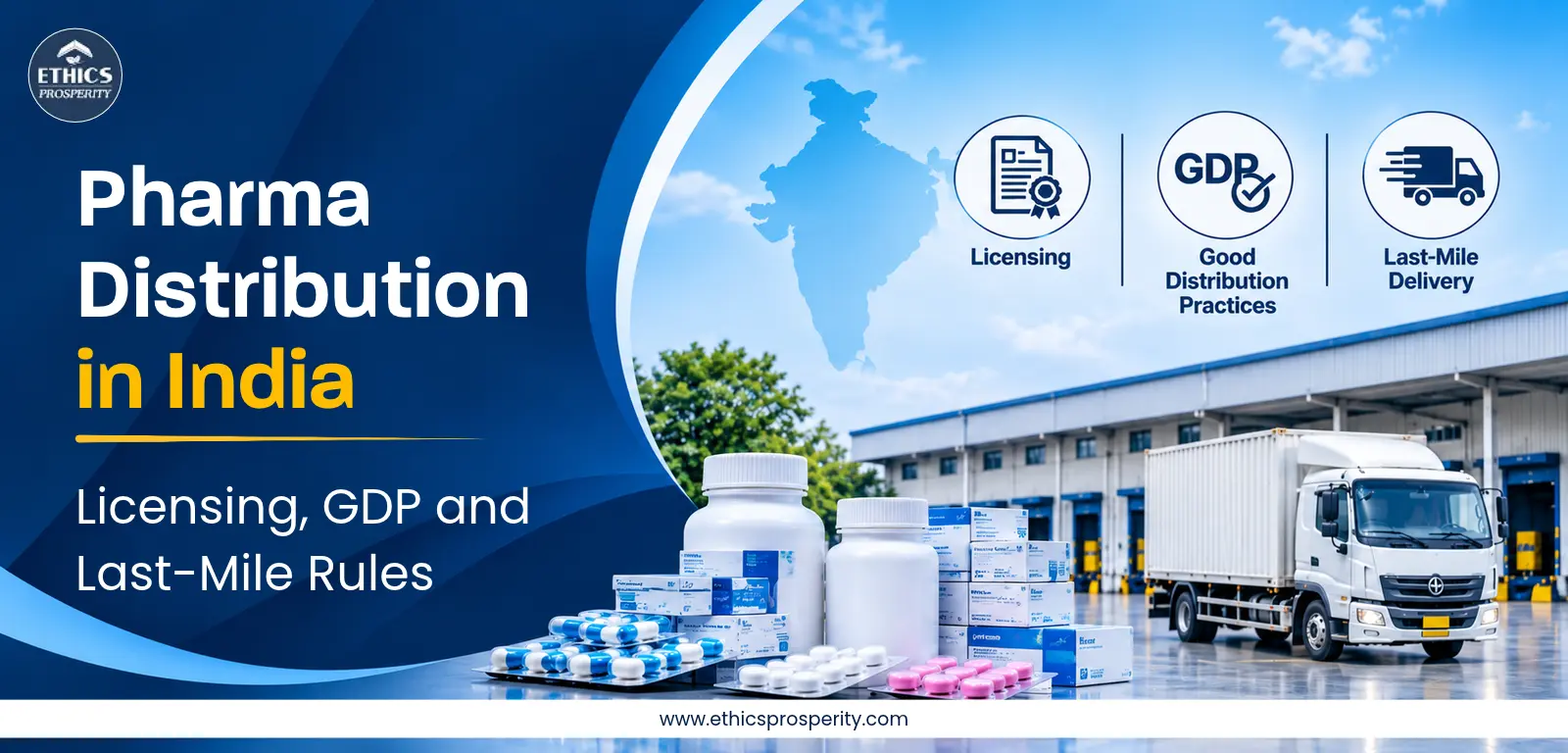
Pharmaceutical distribution is not simply the movement of medicines from a manufacturer to a wholesaler, pharmacy or hospital. It is a controlled process in which product quality, storage conditions, documentation and traceability must be maintained at every stage. A delay, incorrect storage condition or unauthorised handling can affect product quality and create regulatory and patient-safety risks.
As the Indian healthcare market expands, distributors and logistics partners must manage a wider range of products, including temperature-sensitive medicines, vaccines, biologics and speciality therapies. Businesses therefore need a distribution model that combines regulatory compliance with reliable warehousing, transportation and delivery operations.
This guide explains the key licensing considerations, distribution practices, cold-chain requirements and last-mile controls businesses should understand when planning pharmaceutical distribution in India.
Understanding Pharmaceutical Distribution in India
Pharmaceutical distribution connects manufacturers and importers with stockists, wholesalers, hospitals, pharmacies, healthcare institutions and, where legally permitted, patients. The network may involve multiple storage points and transport partners before a product reaches its final destination.
Unlike general cargo, medicines require controls based on their approved storage conditions, packaging information and handling requirements. Some products can be stored under controlled room-temperature conditions, while others require refrigerated or specialised storage. A single distribution network may therefore need multiple handling processes.
The operating model also depends on the customer and channel. B2B vs B2C vs D2C Distribution involves different order sizes, delivery expectations, documentation requirements and service arrangements. Bulk replenishment for hospitals or pharmacies, for example, is operationally different from fulfilling an individual patient order.
Effective Supply chain management in this sector must coordinate product availability, batch-level visibility, expiry control, compliant storage and dependable transportation without compromising product integrity.
Licensing Requirements for Pharma Distribution in India
Pharmaceutical distribution activities are regulated primarily under the Drugs and Cosmetics Act, 1940 and the Drugs Rules, 1945. Businesses must identify the licence applicable to the products they handle and the activities they perform. Requirements can differ according to product category, premises and whether the activity involves wholesale, retail, import or another regulated function.
For wholesale activities, the relevant licence forms commonly include:
-
Form 20B: Wholesale sale, stocking or distribution of drugs other than those covered under Schedules C, C(I) and X.
-
Form 21B: Wholesale sale, stocking or distribution of drugs covered under Schedules C and C(I), excluding Schedule X.
-
Schedule X products: These are subject to separate licensing and additional controls; businesses should confirm the applicable licence and conditions with the relevant State Licensing Authority.
Under the Drugs Rules, licensing authorities assess whether the premises have suitable storage accommodation and whether a competent person is responsible for supervising and controlling the sale, distribution and preservation of drugs.
Before starting operations, businesses should verify:
-
The correct licence category for the products and activities.
-
Premises and storage suitability.
-
Competent-person and staffing requirements.
-
Applicable records, invoices and purchase documentation.
-
Any additional controls for restricted, controlled or specially regulated products.
A licence should not be treated as a one-time administrative formality. Businesses must continue meeting its conditions and applicable legal requirements. Since licensing is administered through the relevant authorities, organisations should confirm current state-level procedures before commencing operations.
2026 regulatory development: On 19 November 2026, the Ministry of Health and Family Welfare announced proposed changes to incorporate Good Storage and Distribution Practices into the Drugs Rules, 1945. A separate licensing framework for wholesale bulk drugs was also proposed. These are draft/proposed changes, not provisions that should be presented as already implemented. Businesses dealing in bulk drugs should monitor the final Gazette notification and applicable transition period.
What Are Good Distribution Practices (GDP) in Pharmaceutical Logistics?
Good Distribution Practices (GDP) provide a framework for maintaining pharmaceutical product quality and identity throughout storage and distribution. They address risks that can arise after manufacturing, including temperature deviations, contamination, product mix-ups, damage, theft and unauthorised distribution.
The CDSCO has published guidance on GDP for pharmaceutical products. The guidance covers quality systems, personnel, premises, storage, temperature control, transportation, documentation, complaints, returns and recalls. Its regulatory status should be checked against the latest notifications: the November 2026 government announcement proposed incorporating GSDP requirements into the Drugs Rules.
For distributors and logistics partners, the practical controls include:
-
Approved sourcing: Purchase products only from appropriately authorised suppliers.
-
Documented procedures: Maintain written procedures for receiving, storage, picking, dispatch and returns.
-
Staff training: Train warehouse and transport teams in product handling, security and escalation procedures.
-
Traceability: Maintain records that connect product batches, quantities, suppliers and recipients.
-
Deviation management: Record and investigate incidents such as damaged packs or temperature excursions.
-
Outsourced activity control: Define responsibilities and quality expectations in agreements with transporters and other service providers.
A distribution partner should be evaluated on its actual operating controls and records, not simply on whether it claims to follow GDP.
Pharmaceutical Warehousing and Cold Chain Management
Pharmaceutical storage facilities must be designed around the conditions specified by the product manufacturer. A facility that is suitable for ordinary ambient medicines may not be appropriate for vaccines, biologics or other temperature-sensitive products.
A Cold storage warehouse should have suitable refrigeration equipment, controlled access, temperature monitoring, alarm arrangements and contingency procedures. Temperature ranges must follow the product label and approved product information; businesses should not assume that every refrigerated medicine uses the same range.
Storage Conditions and Temperature Monitoring
A reliable storage programme should include:
-
Temperature mapping under representative operating conditions.
-
Calibrated monitoring devices and documented checks.
-
Defined procedures for responding to equipment failure and power interruption.
-
Temperature records that can be retrieved for review.
-
Quarantine and assessment of affected stock when a deviation occurs.
For example, if a refrigerated consignment experiences a temperature excursion during a power failure, the stock should not automatically be returned to saleable inventory. The incident must be documented, affected batches identified and the appropriate quality decision obtained before further distribution.
Inventory Control and Product Segregation
Warehouse teams should separate saleable, quarantined, rejected, expired, damaged and recalled products. Batch and expiry details must remain visible during receiving, put-away, picking and dispatch.
FEFO (First Expiry, First Out) is generally a useful inventory rotation method for products with expiry dates. However, it does not replace batch traceability or product-specific quality controls.
Warehouse Management systems can support location accuracy, batch tracking, expiry alerts and controlled stock movement. The facility itself should be selected according to product requirements, operating volume and access to suitable transport infrastructure—not only rental cost.
Last-Mile Pharmaceutical Distribution Rules and Best Practices
The last mile is a critical control point because products move from a distribution facility to a pharmacy, hospital, clinic or other authorised recipient. At this stage, poor handling, extended transit time or inadequate packaging can undermine controls maintained upstream.
A robust cold chain logistics process should preserve the required product conditions during loading, transit, intermediate handling and delivery. The packaging and transport method should be selected according to the product's labelled requirements and the route risk.
Important operating practices include:
-
Route planning: Consider travel time, traffic, delivery windows, weather and the availability of suitable handling facilities.
-
Validated packaging approach: Use packaging and temperature-control arrangements appropriate to the shipment and expected transit conditions.
-
Secure handling: Protect consignments against damage, tampering, theft and unauthorised access.
-
Delivery confirmation: Record the recipient, delivery time, shipment details and any exceptions.
-
What licence is required for pharmaceutical wholesale distribution in India? Define who must be informed when a delivery is delayed, damaged or exposed to an out-of-range condition.
Returns require particular attention. Returned medicines should be identified and segregated rather than immediately added back to saleable stock. Their status should be assessed through an authorised procedure, with the required storage conditions maintained while a decision is pending.
Recall readiness is equally important. Distributors should be able to identify affected batches, trace the customers or locations supplied, stop further dispatch and support reconciliation of recovered quantities.
Role of Technology in Pharmaceutical Distribution
Technology improves visibility and control when it is supported by reliable processes and accurate data. A suitable distribution platform can connect warehouse operations, inventory records, transport updates and customer delivery information.
Useful capabilities include:
-
Batch- and expiry-level inventory visibility.
-
Barcode scanning at receiving, picking and dispatch.
-
Temperature monitoring with alerts and historical records.
-
Shipment tracking and proof of delivery.
-
Electronic records for deviations, complaints and corrective actions.
-
Reports on stock ageing, order accuracy and delivery performance.
For Pharma Logistics, technology should provide more than a shipment-tracking screen. It should help teams identify where a batch is stored, which orders contain it, what conditions it experienced and where it was delivered.
When evaluating technology, businesses should also review access controls, data backup, audit trails and the reliability of system records. Digital visibility is useful only when the underlying information is complete and accurate.
Common Compliance Mistakes in Pharma Distribution
Some distribution failures occur not because a business lacks infrastructure, but because day-to-day controls are inconsistently followed. Common mistakes include:
-
Operating without confirming the correct licence for the product category or activity.
-
Using storage facilities that cannot maintain the required product conditions.
-
Failing to calibrate or review temperature-monitoring equipment.
-
Mixing saleable stock with returned, damaged or quarantined products.
-
Relying on manual records that do not support timely batch-level traceability.
-
Appointing transport partners without clearly documented responsibilities.
-
Failing to investigate delivery deviations and customer complaints.
-
Having no tested process for product recalls.
Businesses should conduct periodic internal reviews and assess service providers against documented quality and operating requirements. Working with warehousing companies in India or transport partners does not transfer away the distributor's own legal and quality responsibilities.
Conclusion
Reliable pharmaceutical distribution depends on more than fast movement and wide delivery coverage. It requires the right licences, suitable storage facilities, trained personnel, batch-level traceability, controlled transportation and a clear response process for deviations, returns and recalls.
Businesses should review their distribution network regularly as product portfolios, customer channels and regulatory requirements change. A capable logistics partner can support these operations through suitable infrastructure, disciplined processes and transparent performance reporting. By combining operational control with dependable Warehousing and Distribution Service, Ethics Prosperity can be considered as part of a business's wider evaluation of supply chain support requirements.