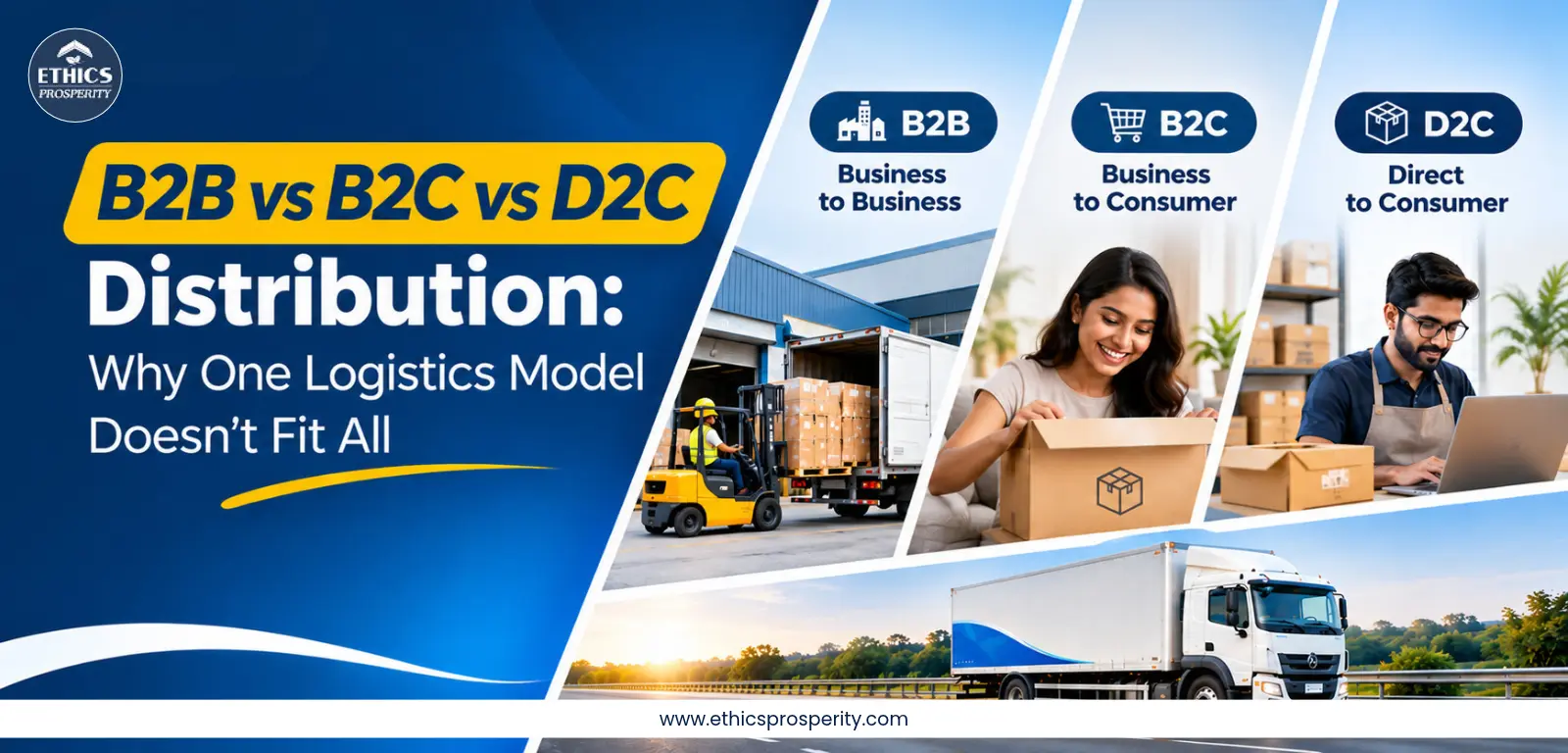
A manufacturer supplying products to retailers, an online marketplace delivering individual customer orders and a brand selling directly through its website may all move goods from one location to another. However, their distribution requirements are very different.
A business-to-business (B2B) operation may handle bulk shipments, scheduled deliveries and multiple retailer locations. A business-to-consumer (B2C) operation must manage individual orders, delivery commitments and customer expectations. A direct-to-consumer (D2C) brand needs to coordinate inventory, online orders, packaging and delivery while maintaining control over the customer experience.
This is why selecting the right distribution strategy is a business decision, not simply a transportation decision. The right model affects inventory positioning, warehouse capacity, operating costs, delivery timelines and customer satisfaction.
Understanding B2B vs B2C vs D2C Distribution helps businesses build logistics operations around the way they sell, the customers they serve and the service levels they promise.
Understanding the Three Distribution Models
Each distribution model serves a different type of customer and requires a different approach to inventory movement, order processing and delivery.
What Is B2B Distribution?
B2B distribution involves supplying products from one business to another. Typical customers include wholesalers, distributors, retailers, manufacturers, dealers and institutional buyers.
For example, an FMCG manufacturer may send palletised products to a regional distributor, who then supplies retail outlets. Similarly, an industrial equipment supplier may deliver machinery or spare parts to factories based on scheduled purchase orders.
Key operational characteristics:
-
Bulk orders and larger shipment quantities.
-
Scheduled dispatches and planned delivery windows.
-
Palletised, carton-based or full-truckload shipments.
-
Customer-specific pricing and delivery requirements.
-
Purchase order, invoice and goods receipt documentation.
-
Greater emphasis on shipment consolidation and vehicle utilisation.
In B2B logistics, delivery accuracy, shipment condition and adherence to agreed schedules are often more important than offering the fastest possible individual delivery.
What Is B2C Distribution?
B2C distribution refers to delivering products directly to individual consumers, usually through retail stores, online marketplaces or other consumer-facing channels.
A customer ordering a mobile phone, household appliance or grocery product expects the correct item to arrive at the promised location and within the stated delivery window.
Key operational characteristics:
-
High volumes of individual customer orders.
-
Multiple delivery destinations.
-
Smaller shipment sizes.
-
Order tracking and delivery notifications.
-
Returns, exchanges and failed-delivery management.
-
Greater focus on customer experience and delivery convenience.
The B2C supply chain must handle changing order volumes, accurate stock availability and customer-specific delivery requirements without allowing fulfilment costs to become unsustainable.
What Is D2C Distribution?
D2C distribution allows a brand or manufacturer to sell directly to consumers without depending entirely on traditional intermediaries such as wholesalers or retailers.
For example, a skincare brand may sell through its own website and fulfil orders from a central warehouse or regional fulfilment location.
Key operational characteristics:
-
Direct control over customer orders and sales channels.
-
Integration between e-commerce platforms and inventory systems.
-
Brand-specific packaging and presentation.
-
Greater responsibility for delivery communication.
-
Direct management of returns and customer feedback.
-
Need for accurate demand forecasting and inventory availability.
For brands investing in D2C logistics, the challenge is to maintain control over the customer experience while building a distribution network that can handle growth.
B2B vs B2C vs D2C: Key Logistics Differences
Although all three models depend on inventory, warehousing and transportation, their operational priorities differ.
|
Comparison factor |
B2B |
B2C |
D2C |
|
Customer |
Business or institution |
Individual consumer |
Consumer buying directly from a brand |
|
Order size |
Generally larger |
Usually smaller |
Usually smaller |
|
Order frequency |
Often planned or scheduled |
Can be frequent and variable |
Depends on brand demand and campaigns |
|
Shipment type |
Bulk, pallet or carton |
Individual parcels |
Brand-specific parcels |
|
Delivery focus |
Schedule and shipment accuracy |
Convenience and delivery experience |
Customer experience and brand control |
|
Inventory strategy |
Bulk and regional stock |
Demand-led availability |
Channel-level inventory visibility |
|
Returns |
Contract or account-based processes |
Consumer returns and exchanges |
Brand-managed returns and exchanges |
|
Key performance focus |
Cost per shipment and OTIF |
Delivery success and order accuracy |
Fulfilment cost and customer retention |
A company operating across multiple channels may need more than one model. For example, a manufacturer can supply retailers in bulk while also selling selected products directly through its website.
The distribution design must account for these differences instead of forcing every order through the same process.
Why One Distribution Model Does Not Fit All
The most suitable distribution model depends on how products are sold, where customers are located, how frequently they order and what service level they expect.
Consider a manufacturer supplying packaged food products to distributors and selling selected products online. Bulk replenishment to distributors may require planned vehicle loads, pallet handling and scheduled deliveries. Online orders require individual picking, packing, labelling and parcel dispatch.
Using the same picking process, packaging rules and dispatch schedule for both channels can create unnecessary handling and operating costs.
A business needs to align its Supply chain management strategy with its commercial model.
Important factors include:
1. Product characteristics: Fragile, temperature-sensitive, bulky or high-value goods need different storage and transportation arrangements.
2. Customer expectations: Retailers may prioritise scheduled replenishment, while individual consumers may expect order tracking and convenient delivery slots.
3. Demand patterns: Seasonal products, promotional campaigns and unpredictable online demand can change inventory and capacity requirements.
4. Geographic coverage: A central facility may work for bulk regional supply, while multiple fulfilment locations may be needed to serve dispersed consumer markets.
5. Cost structure: Businesses must compare storage, handling, packaging, transportation, returns and technology costs across each channel.
An effective Distribution Management strategy balances these factors while maintaining inventory visibility and service consistency.
Key Logistics Challenges Across Distribution Models
The three models face some common challenges, but the impact differs according to the type of order and customer.
1. Inventory visibility across channels
When products are sold through distributors, retail outlets, marketplaces and brand-owned websites, inventory can become fragmented.
Without accurate stock information, businesses risk overselling, delayed replenishment and unnecessary emergency transfers.
2. Rising fulfilment and transportation costs
Smaller orders may require more picking, packing and delivery activity per unit of product. Bulk shipments can offer better vehicle utilisation but may increase inventory holding requirements.
The business must assess the total cost of serving each channel rather than focusing only on transportation rates.
3. Managing returns and reverse logistics
Consumer-facing operations often experience returns due to product preferences, damage, incorrect items or delivery issues. Returned products need inspection and a clear decision on whether they can be restocked, repaired or disposed of.
B2B returns may involve different documentation, quality checks and commercial approvals.
4. Meeting delivery commitments
Traffic conditions, warehouse congestion, inaccurate addresses, vehicle shortages and missed dispatch cut-off times can affect delivery performance.
For consumer orders, last-mile delivery is especially important because it is the final stage customers directly experience.
5. Coordinating multiple sales channels
A business selling through distributors, retail stores, marketplaces and its own website must define inventory allocation rules and order priorities.
Without clear processes, one channel may consume stock needed to fulfil another channel's commitments.
Role of Warehousing and Technology in Distribution
Warehousing is not just a storage function. Its layout, inventory processes and technology directly affect how quickly and accurately orders move through the network.
A well-designed Distribution and Warehouse operation should reflect the business's order profile.
For bulk B2B shipments, the facility may need pallet storage, staging areas and loading capacity. Consumer fulfilment may require dedicated picking zones, packing stations, sorting areas and parcel dispatch arrangements.
Businesses evaluating warehousing companies in India should consider facility location, handling capability, scalability, technology integration and the provider's experience with their product category.
How technology improves distribution performance
Technology connects warehouse activity with order processing and transportation planning.
-
Warehouse Management Systems (WMS): Support receiving, put-away, stock tracking, picking and dispatch.
-
Order Management Systems (OMS): Coordinate orders received through multiple sales channels.
-
Transport Management Systems (TMS): Help plan shipments, allocate vehicles and monitor transportation performance.
-
Barcode and RFID solutions: Improve product identification and inventory accuracy.
-
Analytics and forecasting tools: Help businesses assess demand patterns and plan stock replenishment.
The role of warehouse management is particularly important when a business handles different order types from the same facility. Technology can improve visibility, but the underlying processes and inventory data must also be accurate.
In 2026, businesses are also paying greater attention to flexible fulfilment networks, automation and strategically located facilities. CBRE's H1 2026 India industrial and logistics snapshot reported that 3PL and engineering and manufacturing occupiers accounted for 31% and 26% of leasing absorption respectively, while Delhi-NCR, Chennai and Bengaluru together represented around 60% of activity. This reflects continued demand for logistics infrastructure across major Indian markets.
CBRE India
Sustainability is another consideration. Green Logistics initiatives such as shipment consolidation, efficient route planning, better vehicle utilisation and suitable lower-emission transport options can support environmental objectives while improving resource efficiency.
How to Choose the Right Distribution Strategy
The right model should be selected after assessing commercial requirements and actual operating conditions.
Use the following decision framework:
|
Business requirement |
Distribution approach to evaluate |
|
Bulk supply to dealers and retailers |
B2B distribution |
|
Individual orders through retail or online channels |
B2C distribution |
|
Direct online sales under a brand's control |
D2C distribution |
|
Both wholesale and direct consumer sales |
Multi-channel distribution |
|
High-volume orders across multiple regions |
Regional distribution network |
|
Variable online demand and multiple fulfilment locations |
Integrated fulfilment network |
Before finalising the strategy, businesses should:
-
Map customer locations, order sizes and delivery expectations.
-
Analyse product characteristics and handling requirements.
-
Identify suitable warehouse and fulfilment locations.
-
Define inventory allocation rules across channels.
-
Compare transportation and fulfilment costs.
-
Select technology that integrates orders, inventory and dispatch.
-
Review the operating model periodically as sales channels grow.
A capable logistics partner can help businesses evaluate infrastructure and operational requirements. However, the selection should be based on relevant industry experience, service coverage, technology capability and measurable performance rather than brand size alone.
KPIs to Measure Distribution Performance
A distribution strategy should be evaluated through measurable operating results. The most relevant KPIs depend on the business model.
|
KPI |
What it measures |
Why it matters |
|
On-Time In-Full (OTIF) |
Orders delivered on time and in full |
Measures delivery reliability |
|
Order Accuracy |
Orders fulfilled without errors |
Reduces complaints and rework |
|
Cost per Shipment |
Total distribution cost per shipment |
Supports cost control |
|
Inventory Accuracy |
Match between system and physical stock |
Prevents stock discrepancies |
|
Order Cycle Time |
Time from order receipt to delivery |
Measures fulfilment speed |
|
Vehicle Utilisation |
Use of available vehicle capacity |
Helps control transport costs |
|
Return Rate |
Share of orders returned |
Highlights product or service issues |
|
Perfect Order Rate |
Orders completed accurately and without damage or delay |
Measures overall service quality |
Businesses should review these KPIs by channel rather than combining every order type into one overall performance figure. A bulk retailer shipment and an individual consumer parcel have different cost and service requirements.
This makes it easier to identify whether performance problems originate in inventory, warehouse processing, transportation or customer delivery.
Conclusion
B2B, B2C and D2C distribution serve different commercial needs, and each requires a logistics strategy designed around its customers, order patterns and delivery commitments. A model that works for bulk retail replenishment may not be suitable for individual online orders or direct brand fulfilment.
Businesses should assess their sales channels, product requirements, inventory network, warehouse capabilities and service expectations before selecting a distribution approach. As operations expand, the model should also be reviewed to ensure that capacity, technology and transportation processes remain aligned.
With the right operational planning and logistics infrastructure, Ethics Prosperity can support businesses in building distribution networks that are more organised, responsive and aligned with their supply chain objectives.