The healthcare sector relies heavily on a robust pharmaceutical supply chain process to ensure medicines reach patients safely, efficiently, and without delays. From sourcing raw materials to delivering finished medicines to hospitals and pharmacies, every stage must operate with precision and regulatory compliance.
A single disruption in this system can impact thousands of patients. That is why companies across the world are investing heavily in pharmaceutical supply chain management, focusing on transparency, risk mitigation, and operational resilience.
In India, where healthcare demand continues to grow rapidly, modernizing the Pharma supply chain in India has become essential. Logistics infrastructure, regulatory requirements, cold chain networks, and digital monitoring systems all play a crucial role in ensuring the seamless movement of pharmaceutical products.
Today, supply chain leaders are also integrating technologies such as AI in Supply Chain Management, automation platforms, and predictive analytics to improve visibility and operational efficiency across the entire supply network.
What is Pharmaceutical Supply Chain Management?
Pharmaceutical supply chain management refers to the coordinated process of sourcing raw materials, manufacturing medicines, storing products, and distributing them to healthcare providers.
Unlike traditional supply chains, pharmaceutical logistics must operate under strict compliance requirements because medicines are sensitive products that require controlled environments and accurate tracking.
The pharmaceutical supply chain typically includes:
-
Raw material procurement
-
Drug manufacturing
-
Quality control and regulatory compliance
-
Packaging and labeling
-
Storage and warehousing
-
Distribution to hospitals and pharmacies
These operations require strong coordination between manufacturers, distributors, logistics providers, and healthcare institutions.
Understanding the difference between SCM vs Logistics is also essential here. While logistics focuses mainly on transportation and storage, supply chain management oversees the entire product lifecycle from production to patient delivery.
Key Stages of the Pharmaceutical Supply Chain Process
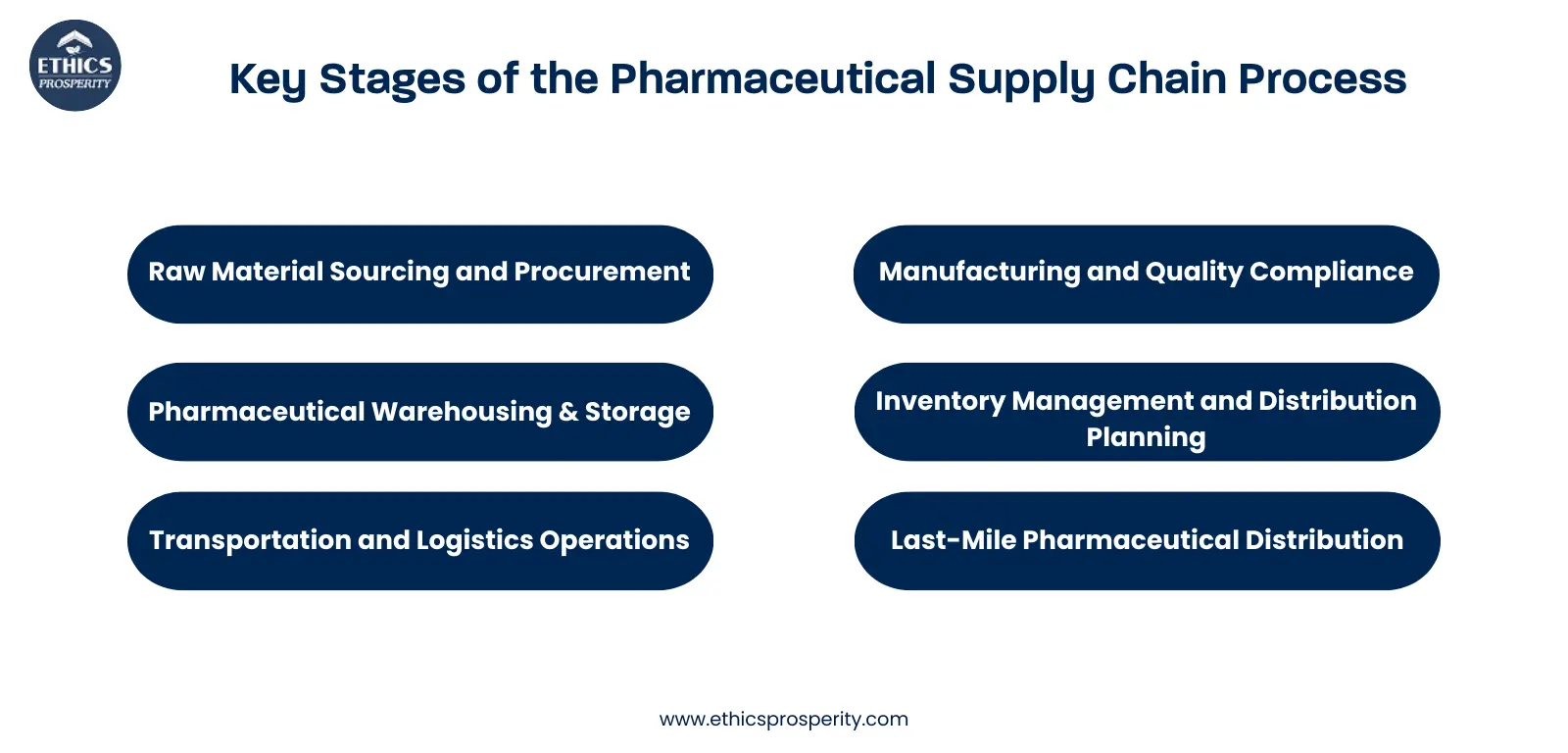
1. Raw Material Sourcing and Procurement
The pharmaceutical journey begins with sourcing active pharmaceutical ingredients (APIs) and other essential materials. Procurement teams must ensure suppliers meet strict regulatory and quality standards.
At this stage, Blockchain in Supply Chain technology is increasingly being explored to create transparent records of ingredient sourcing and supplier verification.
This improves traceability and helps pharmaceutical companies comply with global regulatory frameworks.
2. Manufacturing and Quality Compliance
Once raw materials are sourced, pharmaceutical companies begin the manufacturing process. This stage requires strict compliance with Good Manufacturing Practices (GMP).
Production facilities rely heavily on structured Logistics Management to coordinate incoming materials and outgoing finished goods.
Manufacturers also integrate advanced systems for demand forcasting, allowing them to anticipate market demand and optimize production schedules.
3. Pharmaceutical Warehousing and Storage
After manufacturing, medicines must be stored in specialized pharmaceutical warehouses before distribution.
Many companies rely on professional Warehouse Companies in India that offer regulated storage environments designed for pharmaceutical products.
Important storage infrastructure includes:
-
Cold Storage Warehouses for temperature-sensitive medicines
-
climate-controlled pharmaceutical storage
-
automated inventory systems
-
regulatory compliance monitoring
Modern facilities are also adopting Smart Warehousing, where sensors and IoT devices monitor temperature, humidity, and stock levels in real time.
Some logistics providers even implement Blockchain in smart warehousing to maintain tamper-proof inventory records.
4. Inventory Management and Distribution Planning
Inventory control is critical in the pharmaceutical industry. Expired medicines or incorrect stock levels can lead to major financial losses and health risks.
Companies rely on a Warehouse Management System (WMS) to maintain accurate stock records and ensure medicines are rotated properly.
Efficient distribution management ensures that medicines are dispatched to wholesalers, hospitals, and pharmacies according to demand patterns.
To reduce logistics costs, pharmaceutical companies often ship products using part Truck load transport networks that consolidate shipments across multiple locations.
5. Transportation and Logistics Operations
Transportation is one of the most complex stages of the pharmaceutical supply chain.
Medicines must move quickly while maintaining strict environmental conditions. Logistics providers use specialized vehicles and cold-chain packaging to maintain product integrity.
The transportation network often includes partnerships with 3PL Companies in India that specialize in regulated pharmaceutical logistics.
Many organizations also prefer Outsourcing Logistics to focus on core operations while experts manage transportation and distribution networks.
During this stage, logistics companies must coordinate both inbound and outbound logistics, ensuring smooth movement of materials into manufacturing facilities and finished medicines to market channels.
6. Last-Mile Pharmaceutical Distribution
The final stage of the supply chain involves delivering medicines to hospitals, clinics, pharmacies, and healthcare institutions.
In large urban markets, specialized Last Mile Delivery Companies help ensure faster deliveries, especially during medical emergencies.
With the rapid rise of on-demand delivery platforms, logistics providers are also collaborating with Quick Commerce Companies to accelerate pharmaceutical distribution in metro cities.
This has led to new fulfillment models such as Dark Stores, which function as localized storage facilities designed for ultra-fast delivery.
Some pharmaceutical distributors are even adopting Micro-Fulfillment centers to improve order processing speed and inventory availability.
These models are especially useful in cities where healthcare demand is high.
Technology Transforming Pharma Supply Chains
Technology is playing a crucial role in transforming pharmaceutical logistics operations.
Leading organizations are adopting solutions such as:
-
Ai in logistics for predictive analytics
-
warehouse automation to reduce human errors
-
digital supply chain monitoring platforms
-
advanced inventory visibility systems
These technologies enable companies to move closer to End-to-End Supply Chain Management, where every stage from procurement to delivery is digitally integrated.
Such innovations also help pharmaceutical firms maintain regulatory compliance and operational transparency.
Importance of Reverse Supply Chain in Pharmaceuticals
Pharmaceutical logistics does not end with product delivery. The industry must also manage expired products, recalls, and product returns.
This is where Reverse Supply Chain systems play an important role.
Efficient reverse logistics ensures that returned medicines are safely disposed of or recycled according to regulatory guidelines.
It also protects public health and prevents counterfeit drugs from entering the supply network.
Role of Warehousing and Logistics Infrastructure in India
India’s pharmaceutical industry is one of the largest in the world, supplying medicines to more than 200 countries.
To support this growth, logistics infrastructure must continue evolving.
Integrated Warehouse and Logistics networks allow pharmaceutical companies to store medicines strategically across multiple regions.
Some warehouses even operate as Customs Bonded Warehouse facilities, enabling pharmaceutical exporters to store goods without immediate duty payments until export.
These innovations make India’s pharmaceutical supply chain more efficient and globally competitive.
Even regional hubs like supply chain companies in Bangalore are becoming increasingly important in supporting pharmaceutical distribution across South India.
Challenges in the Pharmaceutical Supply Chain
Despite advancements in logistics infrastructure, pharmaceutical supply chains still face several challenges.
Regulatory Compliance
Pharmaceutical logistics must comply with strict national and international regulations.
Temperature Control
Maintaining cold-chain conditions for vaccines and biologics is complex and costly.
Demand Fluctuation
Unpredictable demand patterns require strong forecasting capabilities.
Supply Disruptions
Global supply shocks can impact raw material availability and production timelines.
To address these challenges, organizations are increasingly partnering with best supply chain companies that offer advanced technology and integrated logistics services.
Conclusion
The pharmaceutical industry depends on a highly structured supply chain to ensure medicines reach patients safely and efficiently.
From raw material sourcing to final delivery, every stage of the pharmaceutical supply chain process must operate with precision, regulatory compliance, and technological support.
With the growing complexity of global healthcare logistics, companies are increasingly adopting digital technologies, automation, and integrated supply chain strategies.
Organizations that invest in modern infrastructure, intelligent forecasting systems, and advanced warehousing solutions will be better positioned to support the future of healthcare distribution.