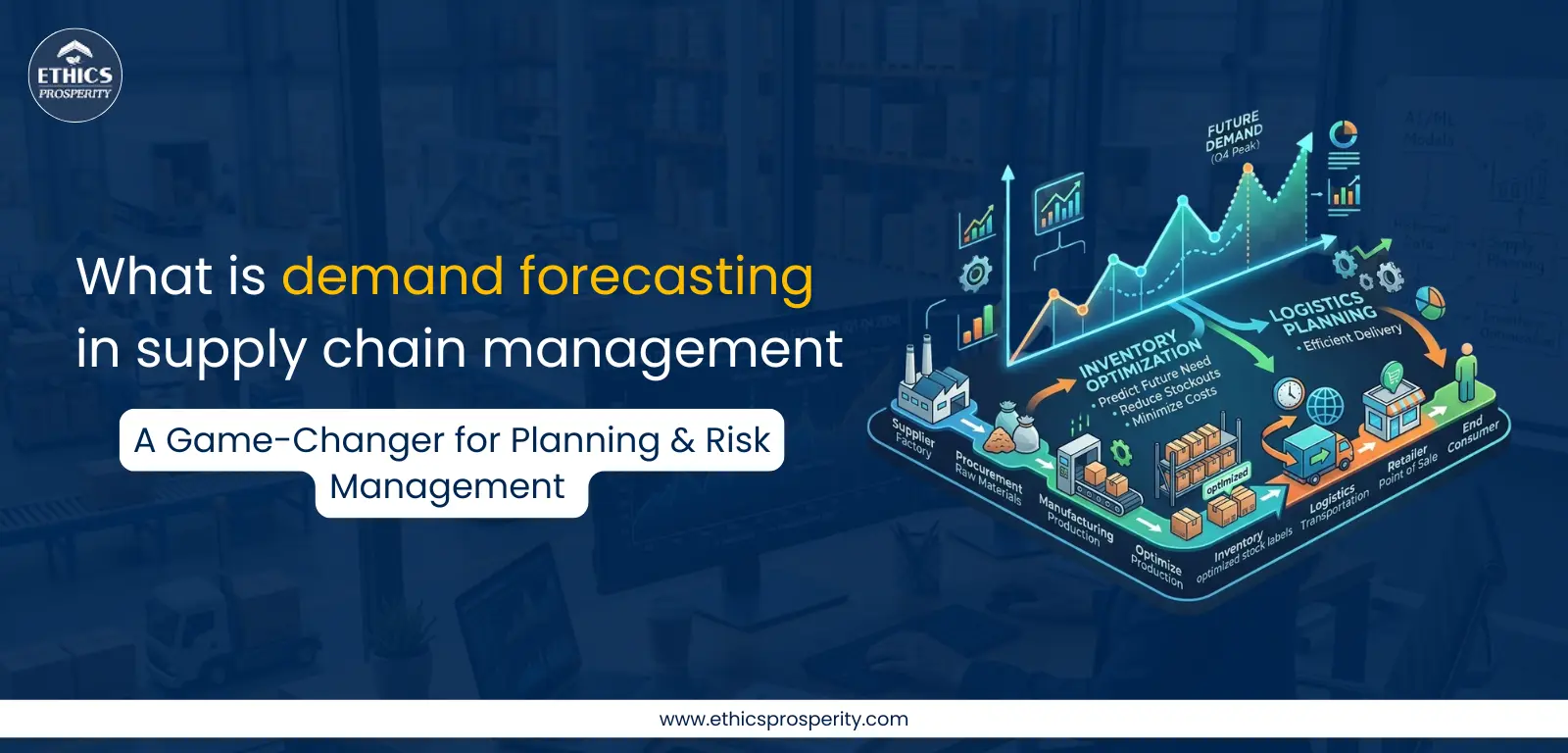
In today’s volatile and customer-driven marketplace, businesses must anticipate demand with precision to remain competitive. Demand forecasting in supply chain has emerged as a critical capability that enables organizations to align production, inventory, and distribution with market needs.
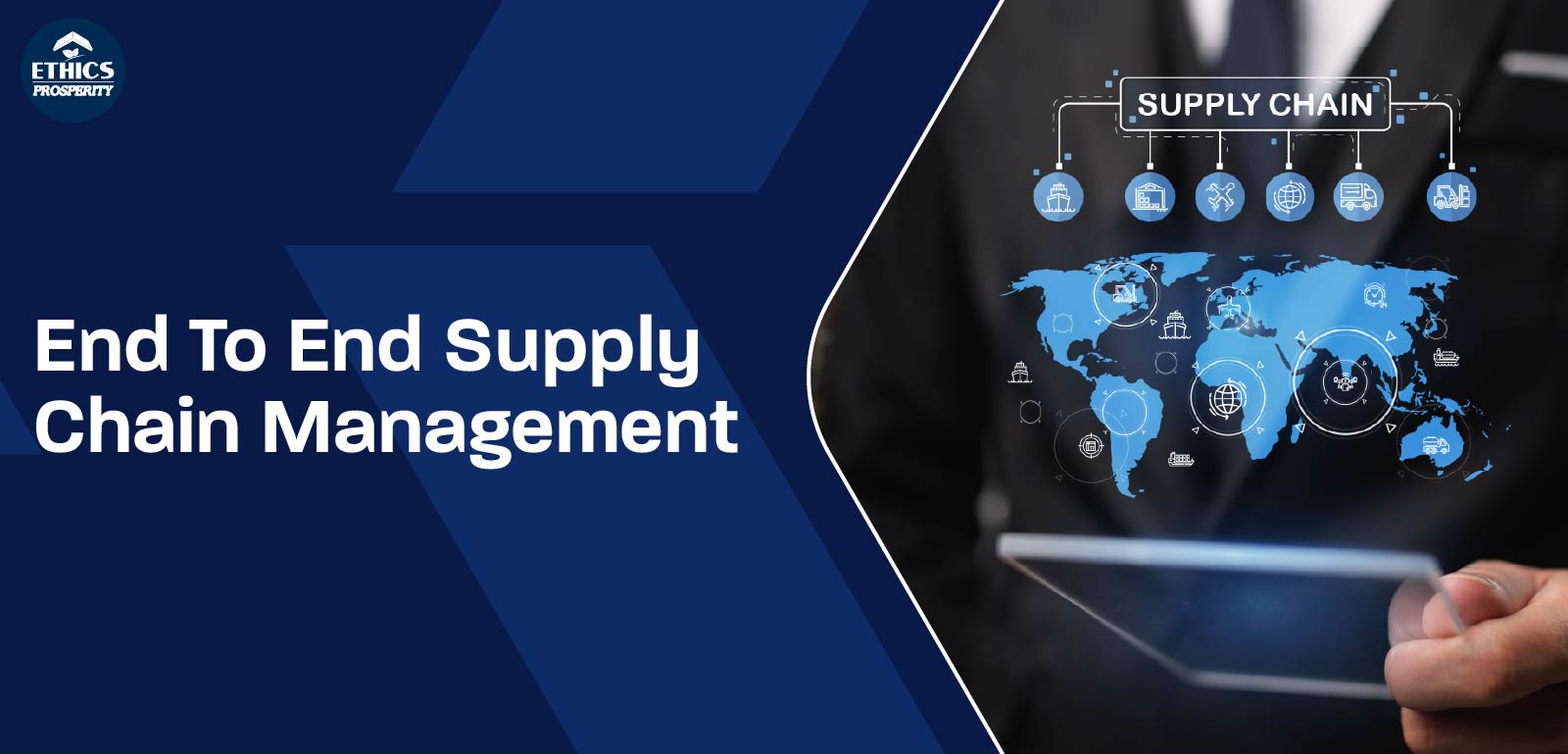
Accurate forecasting not only enhances operational efficiency but also strengthens End-to-End Supply Chain Management, ensuring seamless coordination across procurement, manufacturing, warehousing, and distribution. As industries such as the Pharmaceutical Supply Chain and Supply Chain Management in the Automotive & Engineering Industry face increasing complexity, data-driven forecasting becomes indispensable for sustainable growth.
What is Demand Forecasting in Supply Chain?
Demand forecasting refers to the systematic process of predicting future customer demand using historical data, market trends, and advanced analytical tools. It supports strategic decision-making across Supply Chain Management, enabling organizations to plan resources efficiently and minimize uncertainties.
Modern forecasting leverages Predictive Analytics and AI & Machine Learning to generate accurate and real-time insights. These technologies help businesses anticipate fluctuations, optimize resource allocation, and enhance service levels.
Importance of Demand Forecasting
1. Enhanced Logistics Planning
Effective Logistics Planning ensures that transportation and distribution networks are prepared to meet anticipated demand. Accurate forecasts help businesses allocate resources efficiently and reduce transportation costs while addressing Last Mile Delivery Challenges and Solutions.
2. Inventory Optimization
Forecasting plays a pivotal role in Inventory Optimization by maintaining the right balance between supply and demand. It prevents stockouts and excess inventory, ensuring efficient utilization of Warehousing Solutions and Custom Warehousing facilities.
3. Improved Customer Satisfaction
Meeting customer expectations for product availability and timely delivery is essential, particularly for Quick Commerce Companies. Forecast-driven planning ensures faster fulfillment and reliable service levels.
4. Risk Management
Demand uncertainty can lead to operational disruptions. Forecasting supports proactive Risk Management by identifying potential demand fluctuations and enabling contingency planning.
5. Strategic Decision-Making
Organizations can align procurement, production, and distribution strategies with forecasted demand, ensuring long-term business sustainability and competitiveness.
Key Methods of Demand Forecasting
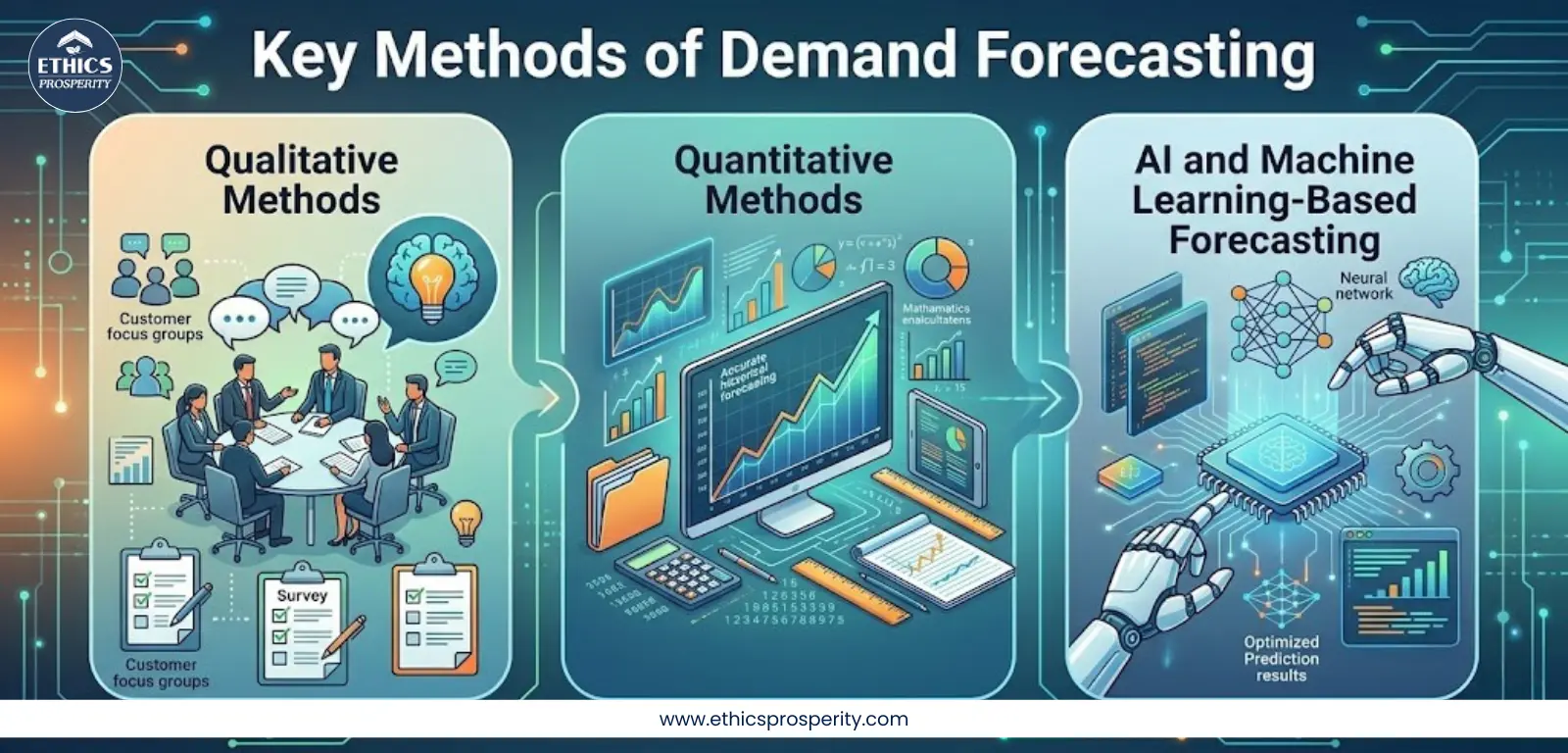
1. Qualitative Forecasting
This method relies on expert judgment, market research, and customer insights. It is particularly useful for new product launches where historical data is limited.
2. Quantitative Forecasting
Quantitative techniques use statistical models and historical data to predict future demand. These models provide higher accuracy and are widely adopted by Top 5 Supply Chain Companies in Bangalore.
3. AI and Machine Learning-Based Forecasting
The integration of AI & Machine Learning enables real-time forecasting by analyzing large datasets and identifying complex demand patterns. This approach significantly enhances accuracy and responsiveness.
Applications of Demand Forecasting Across Industries
1. Pharmaceutical Supply Chain
In the pharmaceutical sector, accurate forecasting ensures the availability of life-saving medications while minimizing wastage. It also supports regulatory compliance and efficient cold chain management.
2. Automotive & Engineering Industry
Within Supply Chain Management in the Automotive & Engineering Industry, forecasting helps synchronize production schedules with supplier capabilities, reducing lead times and operational costs.
3. E-commerce and Quick Commerce
For Quick Commerce Companies, demand forecasting is essential to maintain optimal stock levels and ensure rapid order fulfillment through efficient coordination with Last Mile Delivery Companies.
Role of Technology in Demand Forecasting
1. Warehouse Management System (WMS)
A Warehouse Management System(WMS) provides real-time inventory visibility, enabling organizations to align stock levels with forecasted demand and improve operational efficiency.
2. Predictive Analytics
Predictive Analytics utilizes statistical algorithms and machine learning to analyze historical data and generate accurate demand predictions, supporting informed decision-making.
3. AI & Machine Learning
The adoption of AI & Machine Learning enhances forecasting accuracy by identifying hidden patterns and enabling continuous model improvement.
4. Integration with 3PL Providers
Collaboration with 3PL Companies in India ensures seamless execution of forecast-driven logistics strategies, enabling scalability and operational flexibility.
5. Smart Warehousing and Distribution
Forecast insights enable businesses to optimize storage and distribution networks, including partnerships with the Top 10 Warehousing Companies in Gurugram for strategic inventory positioning.
Benefits of Demand Forecasting in Supply Chain
1. Cost Reduction
Accurate forecasting minimizes excess inventory and emergency transportation costs, leading to significant savings.
2. Improved Operational Efficiency
Forecast-driven planning enhances coordination across procurement, production, and distribution processes.
3. Enhanced Supply Chain Visibility
Real-time insights enable better monitoring and control of supply chain activities.
4. Better Supplier Collaboration
Reliable forecasts strengthen relationships with suppliers by providing clear demand expectations.
5. Increased Business Agility
Organizations can quickly adapt to market changes and disruptions, ensuring continuity and resilience.
Common Challenges in Demand Forecasting
1. Data Silos
Fragmented data across systems can hinder accurate forecasting and decision-making.
2. Market Volatility
Unpredictable economic and geopolitical factors can impact demand patterns.
3. Limited Historical Data
New businesses or product launches may lack sufficient data for reliable forecasting.
4. Integration Complexity
Aligning forecasting tools with existing systems requires significant investment and expertise.
5. Overreliance on Manual Processes
Manual forecasting methods are prone to errors and inefficiencies, emphasizing the need for automation.
Best Practices for Effective Demand Forecasting
-
Leverage Advanced Technologies: Utilize AI and predictive analytics for improved accuracy.
-
Enhance Data Integration: Ensure seamless data flow across supply chain systems.
-
Collaborate with Stakeholders: Engage suppliers and logistics partners in the forecasting process.
-
Continuously Monitor and Adjust: Regularly update forecasts based on real-time data.
-
Adopt Scenario Planning: Prepare for potential disruptions through contingency strategies.
Future Trends in Demand Forecasting
1. Real-Time Forecasting
Advancements in digital technologies will enable continuous forecasting based on live data.
2. Integration with Digital Supply Chains
Forecasting will become an integral component of digitally connected supply chain ecosystems.
3. Sustainability-Driven Planning
Organizations will increasingly align forecasting with sustainability goals to reduce waste and optimize resource utilization.
4. Collaborative Forecasting
Enhanced collaboration among supply chain partners will lead to more accurate and synchronized planning.
Conclusion
Demand forecasting in supply chain is a strategic enabler that empowers organizations to anticipate market needs, optimize resources, and enhance operational efficiency. By leveraging advanced technologies and adopting best practices, businesses can build resilient and agile supply chains capable of navigating market uncertainties.
Organizations that integrate forecasting into their End-to-End Supply Chain Management strategies will achieve superior customer satisfaction and long-term growth. Ethics Prosperity supports businesses with data-driven supply chain solutions, enabling smarter decision-making and sustainable success.