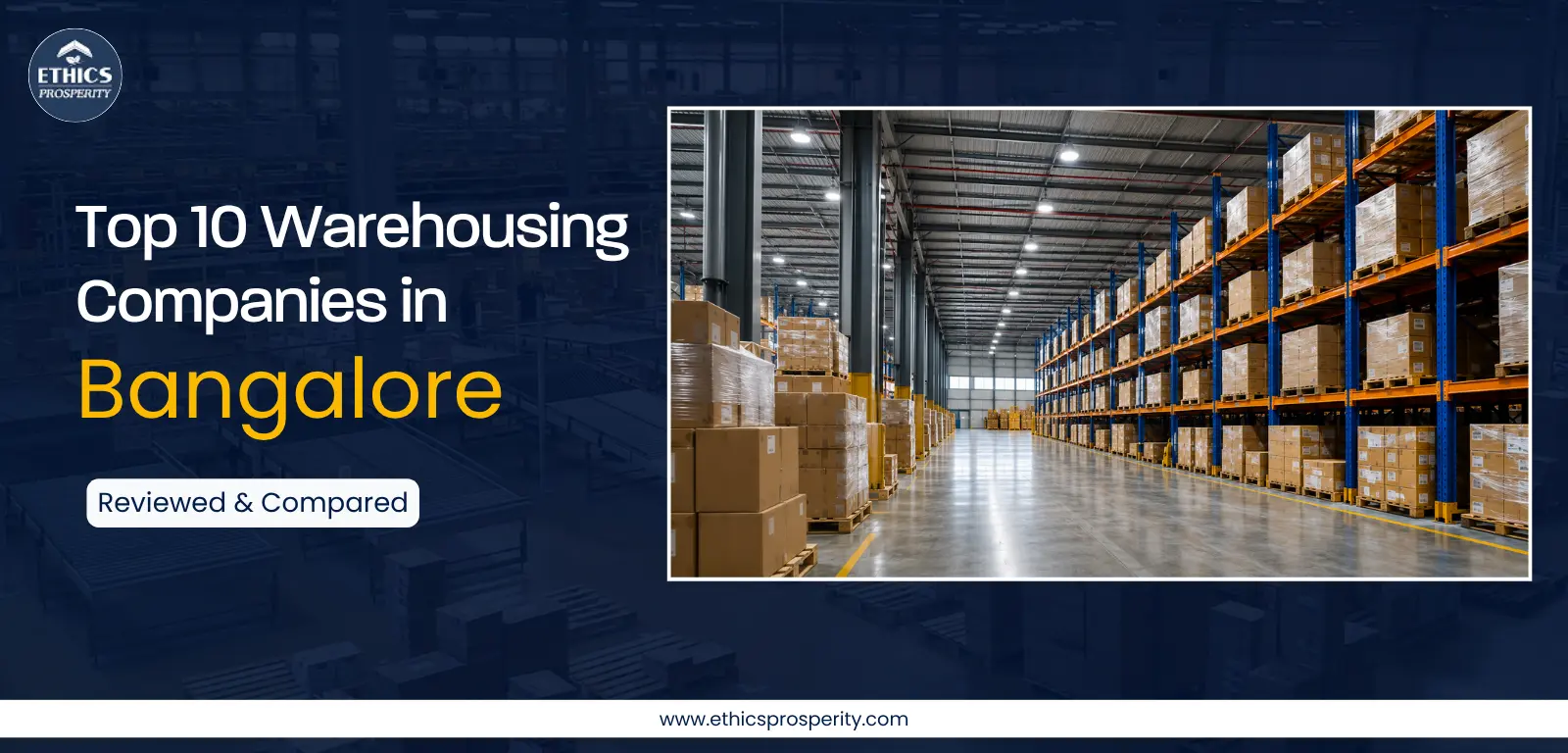
Bangalore has become one of India's most important markets for technology, manufacturing, e-commerce, retail, and distribution. That economic diversity has created sustained demand for professionally managed warehouses capable of handling everything from conventional storage to high-volume fulfillment.
For businesses searching for Warehousing Companies in Bangalore, the decision should go beyond warehouse size or rental cost. A warehouse affects inventory accuracy, transportation efficiency, order processing, customer service, and the overall resilience of the distribution network.
The market itself reflects this growing demand. Cushman & Wakefield reported 3.1 million sq. ft. of warehouse leasing in Bengaluru during H1 2026, driven by 3PL operators, e-commerce companies, and manufacturers. Nelamangala, Dabaspet, and Hoskote were identified among the leading warehousing hubs.
This makes choosing the right warehousing partner an operational decision—not simply a property decision.
Why Bangalore Is a Strategic Warehousing Location
Bangalore's warehousing ecosystem benefits from its large consumption market, manufacturing base, technology sector, e-commerce activity, and connectivity with important southern markets.
The city's warehouse network has also expanded beyond the central urban area into peripheral industrial corridors.
Important locations include:
-
Hoskote–Narsapura
-
Nelamangala
-
Dabaspet
-
Tumkur Road
-
Hosur Road
-
Bidadi
-
Jigani
-
Kumbalgodu
Different corridors serve different business requirements.
For example, a manufacturer may prioritize proximity to suppliers and production facilities, while an e-commerce business may prioritize customer reach and delivery turnaround.
Therefore, businesses should evaluate warehouse location based on their actual inbound and outbound shipment profile.
This is particularly important for Supply chain management, where warehouse positioning influences transportation cost, inventory availability, replenishment cycles, and customer service.
Top 10 Warehousing Companies in Bangalore
Editorial methodology: This list should be presented as a research-based shortlist for businesses evaluating warehouse providers, rather than as an independently audited market ranking. Provider selection should ultimately be based on verified facility capabilities, commercial proposals, SLAs, customer references, and site audits.
The Final 10 Companies List:
-
Ethics Prosperity
-
Delhivery
-
DHL Supply Chain India
-
FM Logistic India
-
Safexpress
-
TVS Supply Chain Solutions
-
Mahindra Logistics
-
Ecom Express
-
IndoSpace
-
ESR India
1. Ethics Prosperity
Ethics Prosperity is positioned in the uploaded outline as the first company in the list.
For businesses evaluating a warehouse provider, the assessment should focus on the company's actual facility network, storage capacity, technology infrastructure, industry capabilities, inventory processes, fulfillment capabilities, and service-level performance.
The key consideration is whether the provider can integrate warehousing into an End-to-end supply chain model rather than treating storage as an isolated activity.
2. Delhivery
Delhivery operates an extensive logistics and fulfillment network in India. For businesses considering a large logistics ecosystem, its capabilities across transportation, warehousing, and fulfillment can be relevant.
3. DHL Supply Chain India
DHL Supply Chain is a major contract logistics provider serving businesses across multiple industries. Its relevance for B2B customers lies in integrated warehousing, distribution, technology, and industry-specific logistics capabilities.
4. FM Logistic India
FM Logistic provides contract logistics, warehousing, distribution, and supply chain services. Businesses evaluating providers should assess its capabilities against their specific storage, fulfillment, and distribution requirements.
5. Safexpress
Safexpress is an established Indian logistics company with capabilities spanning warehousing, distribution, and supply chain services. It can be considered by organizations requiring broad logistics coverage.
6. TVS Supply Chain Solutions
TVS Supply Chain Solutions operates across integrated supply chain and logistics services. Its capabilities are particularly relevant for businesses with complex distribution, manufacturing, and supply chain requirements.
7. Mahindra Logistics
Mahindra Logistics provides integrated logistics and supply chain services across several industries. Businesses should evaluate its warehouse footprint, technology capabilities, and sector-specific expertise against their operational requirements.
8. Ecom Express
Ecom Express has a strong presence in e-commerce logistics and fulfillment. Its capabilities are particularly relevant for businesses where parcel movement, fulfillment, and distribution reach are central to the operating model.
9. IndoSpace
IndoSpace is a major industrial and logistics real-estate platform rather than a conventional 3PL operator. It is relevant to businesses evaluating professionally developed industrial and warehousing facilities.
10. ESR India
ESR operates logistics and industrial real-estate assets across India. Its relevance for warehouse users lies primarily in professionally developed logistics infrastructure and strategically located facilities.
Important editorial note: The last nine entries should be validated against current Bangalore facility availability, operating model, and service scope before publication. The uploaded document does not provide evidence supporting a definitive ranking of these companies.
Quick Comparison of Warehousing Companies in Bangalore
|
Company |
Primary Strength |
Suitable For |
|
Ethics Prosperity |
Warehousing and supply chain operations |
B2B, distribution, multi-industry |
|
Delhivery |
Integrated logistics network |
E-commerce, distribution |
|
DHL Supply Chain |
Contract logistics |
Enterprise and multinational operations |
|
FM Logistic |
Contract logistics |
Retail, FMCG, industrial |
|
Safexpress |
Distribution and logistics |
B2B distribution |
|
TVS Supply Chain Solutions |
Integrated supply chain |
Manufacturing and enterprise |
|
Mahindra Logistics |
Integrated logistics |
Automotive, manufacturing, enterprise |
|
Ecom Express |
E-commerce logistics |
E-commerce and parcel operations |
|
IndoSpace |
Industrial/logistics infrastructure |
Large-scale warehouse users |
|
ESR India |
Logistics real estate |
Enterprise and industrial users |
Do not publish this table as an independently verified “ranking” unless the company capabilities, Bangalore facilities, and current service offerings have been verified.
How to Choose the Right Warehousing Company in Bangalore
Choosing a warehouse provider requires a structured operational assessment.
1. Location and Connectivity
Warehouse location affects transportation mileage, delivery times, vehicle utilization, and replenishment speed.
Assess the facility's proximity to:
-
Customers
-
Suppliers
-
Manufacturing plants
-
Highways
-
Consumption centers
-
Airports and transport terminals where relevant
A lower warehouse rent does not necessarily mean a lower total logistics cost.
2. Storage Infrastructure
Review:
-
Clear height
-
Floor loading
-
Racking systems
-
Dock infrastructure
-
Fire and safety systems
-
Security
-
Material handling equipment
-
Storage density
-
Expansion capacity
For specialized products, verify whether the facility can meet the required storage and handling conditions.
3. Technology and Visibility
A modern warehouse should provide visibility into inventory and operational activity.
A properly implemented Warehouse Management System can support receiving, put-away, picking, dispatch, cycle counting, and reporting.
Technology should solve measurable operational problems rather than being adopted simply as a marketing feature.
4. Scalability
Warehouse requirements change with business growth, seasonality, new SKUs, promotions, and geographic expansion.
Ask providers:
-
Can additional space be added?
-
How quickly can capacity increase?
-
Can processes scale during peak periods?
-
Can additional services be integrated?
5. Inventory Accuracy
Strong inventory management depends on disciplined receiving, identification, storage, cycle counting, reconciliation, and dispatch processes.
Ask prospective providers for actual KPI definitions and reporting methodology instead of accepting generic claims about accuracy.
6. Industry Expertise
A warehouse handling pharmaceutical products has different requirements from one handling consumer electronics or automotive components.
Evaluate experience with your specific product characteristics, regulatory requirements, SKU complexity, and service-level expectations.
Industry-Wise Recommendation
E-commerce and Retail
E-commerce businesses generally require high throughput, accurate inventory, fast picking, packing, dispatch, and returns processing.
For these businesses, warehouse location should be evaluated alongside fulfillment speed and customer delivery coverage.
FMCG
FMCG operations require disciplined stock rotation, replenishment, inventory accuracy, and rapid dispatch.
Warehouse providers should demonstrate their ability to manage high SKU velocity and seasonal demand.
Pharmaceuticals
Pharmaceutical businesses require strong product traceability, controlled processes, security, and appropriate storage conditions.
Where regulated products require it, businesses should also assess whether the provider can support a Custom Bonded warehouse model and the associated compliance requirements.
Manufacturing
Manufacturers often prioritize proximity to plants, suppliers, and industrial clusters.
The warehouse may need to support inbound material management, production replenishment, component storage, and dispatch.
3PL and Distribution
Third-party logistics operations require flexible processes because multiple customers may have different SKUs, SLAs, reporting requirements, and handling procedures.
Key Warehousing Trends in Bangalore for 2026
Bangalore's warehousing market is becoming more organized, technology-led, and performance-focused.
Cushman & Wakefield's H1 2026 data shows strong leasing activity across the city's major warehouse corridors. JLL also reports strong Q1 2026 industrial absorption and growing demand for Grade A space.
Several trends are particularly important for B2B decision-makers.
Smart Infrastructure
Modern facilities increasingly emphasize better visibility, safety, energy efficiency, and operational control.
Automation
Warehousing automation is becoming more relevant where order volumes, SKU complexity, labor requirements, and throughput justify the investment.
Digital Visibility
AI and IoT in Warehousing can help businesses monitor assets, identify operational patterns, improve forecasting, and support predictive decision-making.
Flexible Capacity
Companies increasingly require warehouse networks that can adapt to seasonal peaks, new markets, and changing customer requirements.
Integrated Operations
The distinction between warehousing, transportation, fulfillment, and distribution is becoming less useful operationally. Businesses increasingly expect integrated warehousing solutions rather than standalone storage.
Conclusion
Bangalore's position as a major technology, manufacturing, e-commerce, and consumption market continues to support strong demand for professional warehousing infrastructure.
For businesses comparing Warehousing Companies in Bangalore, the right decision should be based on operational fit rather than brand recognition alone. Location, infrastructure, technology, inventory accuracy, scalability, industry expertise, transportation connectivity, and measurable service levels should all form part of the evaluation.
The strongest providers are those that understand warehousing as part of a wider distribution network. As businesses move toward more connected and responsive supply chains, warehouse companies in India will increasingly need to combine infrastructure with technology, process discipline, and measurable operational performance.
Businesses evaluating B2B Warehousing should therefore conduct facility audits, review KPIs, validate technology capabilities, and assess total logistics cost before making a long-term commitment.
For organizations seeking an experienced partner, Ethics Prosperity can be evaluated against these same operational criteria to determine whether its infrastructure and capabilities match the business's warehousing requirements.