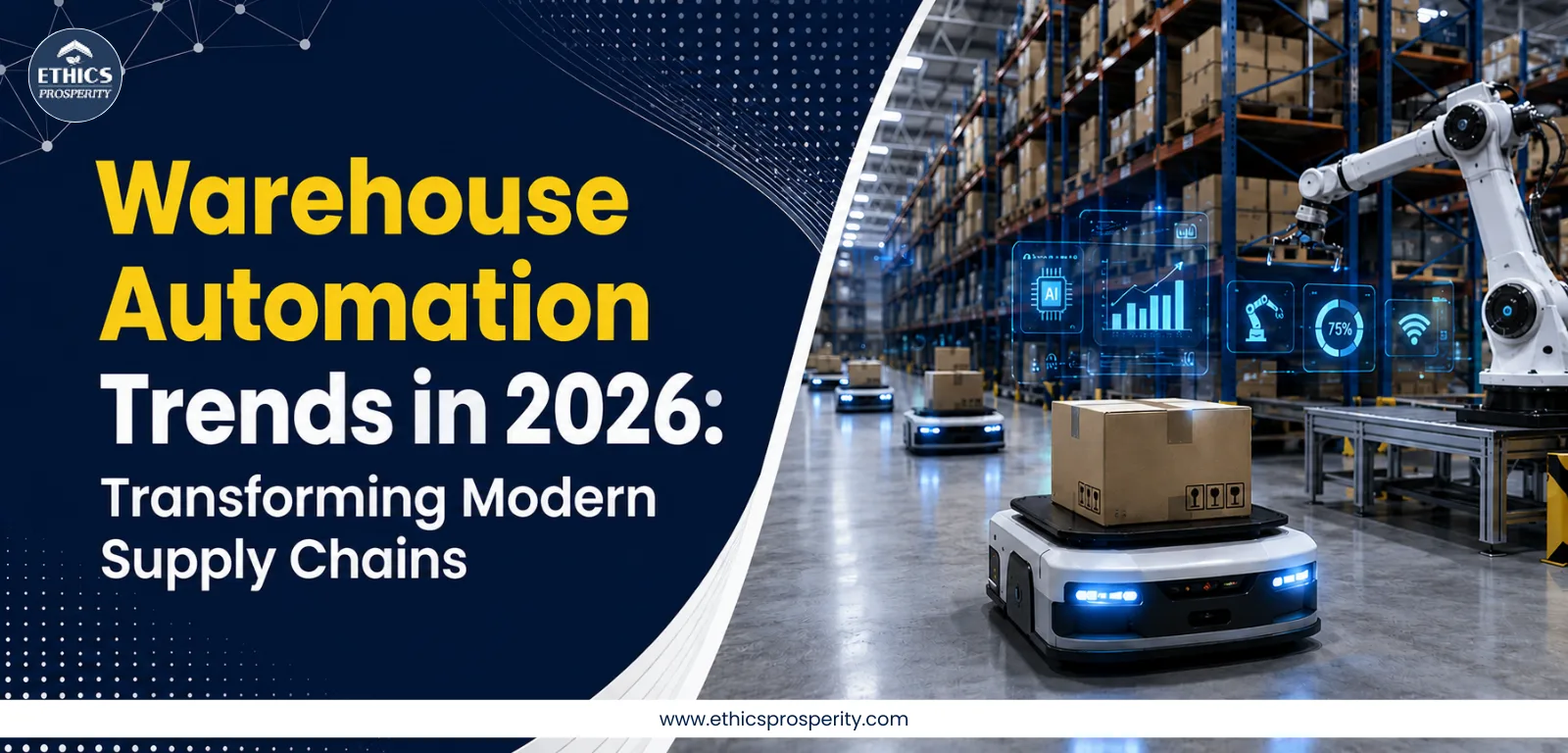
Warehousing has evolved from a storage-focused function into a strategic pillar of business growth. In today's highly competitive environment, warehouse performance directly influences customer satisfaction, inventory availability, operating costs, and overall supply chain resilience.
The rapid growth of e-commerce, omnichannel retail, quick commerce, and customer expectations for faster deliveries is forcing organizations to rethink traditional warehouse operations. Manual processes that once supported business requirements are increasingly becoming operational bottlenecks.
As we move through 2026, automation is no longer viewed as a future investment—it has become a critical business requirement. Organizations that successfully adopt modern automation technologies are improving efficiency, increasing accuracy, and building scalable operations capable of supporting long-term growth.
This article explores the most important Warehouse Automation Trends shaping modern logistics operations and what business leaders should consider when planning their automation strategy.
Why Warehouse Automation Is No Longer Optional
The Growing Complexity of Modern Supply Chains
Today's warehouse operations must support increasingly complex fulfillment networks, larger product catalogs, fluctuating demand patterns, and multi-channel distribution requirements.
Modern Supply chain management requires real-time responsiveness, operational agility, and data-driven decision-making. Traditional warehouse models often struggle to meet these expectations while maintaining profitability.
The challenge becomes even greater as businesses expand their regional and national distribution networks.
Rising Customer Expectations and Service Levels
Customers now expect faster deliveries, greater order accuracy, and real-time shipment visibility. These expectations are pushing organizations to modernize warehouse operations and reduce dependency on manual processes.
Warehouse automation helps organizations improve throughput, shorten processing times, and maintain service consistency even during peak demand periods.
Top Warehouse Automation Trends in 2026
AI-Powered Warehouse Decision-Making
Artificial intelligence is rapidly becoming the intelligence layer behind warehouse operations. AI systems can analyze inventory movement, labor productivity, order patterns, and operational bottlenecks to recommend optimal actions.
Organizations are increasingly using AI to improve resource allocation, slotting optimization, and operational planning across the End-to-end supply chain.
Autonomous Mobile Robots (AMRs)
AMRs continue to be one of the fastest-growing automation investments in warehousing. Unlike fixed automation systems, AMRs provide flexibility by navigating dynamically through warehouse environments.
These robots assist with picking, replenishment, transportation, and sorting activities while reducing travel time and labor dependency.
Goods-to-Person Automation
Goods-to-person systems are becoming a preferred solution for high-volume fulfillment operations. Instead of employees traveling through warehouse aisles, automated systems bring inventory directly to workstations.
This significantly improves picking productivity and supports advanced Logistics solutions designed for high-throughput environments.
Digital Twins and Predictive Operations
Digital twin technology enables businesses to create virtual warehouse replicas that simulate operational performance before implementing physical changes.
Warehouse managers can evaluate layout modifications, labor strategies, and capacity planning scenarios without disrupting live operations.
Computer Vision and Intelligent Quality Control
Computer vision technologies are helping warehouses improve accuracy and reduce errors. These systems verify products, identify damaged goods, and support automated quality inspections throughout the fulfillment process.
Many leading Supply chain companies are investing heavily in computer vision to improve operational consistency.
Automated Storage and Retrieval Systems (ASRS)
ASRS technology continues to gain momentum in 2026 due to increasing warehouse space constraints and labor shortages.
These systems maximize storage density while improving inventory accessibility and reducing manual handling requirements.
Connected Warehouse Ecosystems
The most advanced facilities are no longer operating as isolated warehouses. Instead, they function as connected ecosystems that integrate transportation, procurement, inventory planning, and fulfillment activities.
Many large Warehouse companies are building highly connected operational environments that support end-to-end visibility.
Benefits of Warehouse Automation in 2026
Improved Productivity
Automation significantly reduces non-value-added activities and improves workforce productivity. Employees can focus on higher-value tasks while repetitive processes are handled through automated systems.
Higher Inventory Accuracy
Maintaining accurate inventory records remains one of the biggest warehouse challenges.
Automation technologies strengthen Inventory management by reducing manual errors and improving stock tracking capabilities.
Integration with a modern Warehouse Management System further enhances inventory control and operational visibility.
Reduced Operating Costs
Although automation requires upfront investment, long-term benefits often include lower labor costs, improved space utilization, reduced errors, and higher operational efficiency.
Organizations managing large-scale Order fulfillment operations often achieve significant productivity gains through automation.
Enhanced Scalability
One of the most important advantages of automation is scalability. Automated facilities can support business growth without proportional increases in labor requirements.
This capability is becoming increasingly important as Smart warehousing initiatives gain momentum across industries.
Industries Leading Warehouse Automation Adoption
E-commerce and Retail
E-commerce continues to drive warehouse innovation. Businesses are investing heavily in automation to support rapid fulfillment, high order volumes, and increasing customer expectations.
FMCG
Fast-moving consumer goods organizations use automation to improve throughput, inventory rotation, and demand responsiveness.
Automation also supports more accurate Demand forecasting by generating real-time operational data.
Healthcare and Pharmaceuticals
Healthcare organizations rely on automation to maintain compliance, improve traceability, and ensure product integrity across sensitive inventory categories.
Automotive and Manufacturing
Manufacturers are using automation to support production continuity, inventory optimization, and lean operational practices.
Many organizations are integrating warehouse technologies into broader Supply chain automation initiatives to improve operational synchronization.
Key Challenges Businesses Should Consider
Technology Investment
Automation projects require careful financial planning. Organizations must evaluate return on investment, scalability, and long-term operational impact before implementation.
Integration Complexity
Warehouse automation should integrate seamlessly with existing business systems, transportation networks, and operational workflows.
Workforce Transformation
Automation changes workforce requirements rather than eliminating them. Businesses must invest in training programs that help employees work alongside advanced technologies.
Cybersecurity Risks
As warehouses become increasingly connected, cybersecurity becomes a critical operational consideration.
Systems utilizing IoT devices and connected platforms require robust security frameworks to protect operational data and business continuity.
How to Build a Future-Ready Automated Warehouse
Assess Operational Bottlenecks
Successful automation starts with identifying operational inefficiencies. Businesses should evaluate picking productivity, inventory accuracy, labor utilization, and throughput performance.
Develop a Scalable Automation Roadmap
Rather than automating everything simultaneously, organizations should prioritize high-impact areas and implement automation in phases.
This approach supports long-term Sustainability goals while minimizing operational disruption.
Prioritize Data Visibility
Automation is only as effective as the quality of data supporting it. Real-time visibility enables better decision-making and continuous improvement.
Measure Performance Continuously
Key performance indicators should include inventory accuracy, productivity, order cycle time, fulfillment speed, labor utilization, and customer service levels.
These metrics help organizations align automation investments with evolving Supply chain trends.
For many growing businesses, collaboration with experienced Warehouse companies in India can accelerate automation adoption while reducing implementation risks.
The Future of Warehouse Automation Beyond 2026
AI-Driven Autonomous Warehouses
The next generation of warehouses will increasingly rely on AI-driven systems capable of making operational decisions with minimal human intervention.
Predictive Supply Networks
Warehouses will become more tightly connected to broader supply networks, enabling predictive planning and proactive risk management.
Human-Machine Collaboration
Future warehouse operations will combine human expertise with intelligent automation to achieve higher levels of productivity, flexibility, and resilience.
Organizations that begin investing today will be better positioned to compete in increasingly digital and customer-centric markets.
Conclusion
Warehouse automation is no longer simply about reducing labor costs or increasing throughput. It has become a strategic enabler of operational excellence, customer satisfaction, and long-term business growth.
The leading Warehouse Automation Trends in 2026 demonstrate that successful organizations are moving toward intelligent, connected, and highly scalable warehouse environments. From AI-driven decision-making and robotics to predictive analytics and digital twins, automation technologies are redefining how warehouses operate and deliver value.
Businesses that adopt a structured automation strategy today will be better equipped to manage complexity, improve efficiency, and strengthen supply chain resilience in the years ahead. Organizations seeking to modernize warehouse operations and create future-ready logistics networks can accelerate their transformation journey with trusted partners such as Ethics Prosperity.