The logistics and supply chain industry is undergoing a major transformation as businesses respond to rising customer expectations, growing operational complexity, and the demand for faster, more reliable delivery. With logistics contributing nearly 11% of global carbon emissions and customer expectations for faster delivery rising by over 60%, organizations are increasingly adopting AI in logistics to enhance efficiency, accuracy, and real-time visibility across their operations.
By leveraging Logistics automation and connected data systems, companies are achieving operational improvements of up to 30% while building resilient, adaptive, and scalable Smart supply chains. AI allows businesses to anticipate demand fluctuations, optimize resources, and streamline workflows, creating logistics networks that are both efficient and responsive to market dynamics.
What Is AI in Logistics?
AI in logistics involves applying technologies like machine learning, predictive analytics, and intelligent automation to optimize operations such as warehousing, transportation, and inventory management. These systems process large volumes of data, identify trends, and provide actionable insights that improve efficiency, reduce errors, and support smarter decision-making across the supply chain. By anticipating demand changes and optimizing resources, AI helps create faster, more reliable logistics networks.
Integrated with modern Supply chain Solutions, AI enhances planning, transportation coordination, and distribution efficiency. It can recommend optimal inventory levels, streamline picking and packing through Warehouse automation Systems, determine efficient delivery routes, and allocate resources effectively, reducing operational costs and improving overall performance. This allows teams to focus on strategic tasks while AI handles real-time optimization and complex logistics analysis.
The convergence of AI with IOT data provides continuous real-time visibility into inventory, assets, and vehicles. Organizations can detect potential disruptions early, respond quickly to market changes, and maintain seamless operations. Together, these technologies help build adaptive, resilient, and fully Smart supply chains capable of scaling efficiently and consistently meeting customer expectations.
Key Applications of AI in Logistics Operations
AI in logistics is revolutionizing operations by automating processes, improving accuracy, and enabling smarter decision-making. Businesses can leverage AI across multiple areas to build efficient and responsive Smart supply chains.
Applications:
-
Demand forecasting and inventory optimization – AI predicts future demand and optimizes inventory levels to reduce stockouts and overstock, improving overall supply chain efficiency.
-
Warehouse operations and automation – AI-powered Warehouse automation Systems streamline picking, packing, and storage, increasing speed, accuracy, and throughput.
-
Transportation and route optimization – AI analyzes traffic, delivery priorities, and environmental factors to optimize routes, reduce costs, and enhance last mile delivery performance.
-
Predictive maintenance and fleet management – Using IOT data, AI anticipates equipment or vehicle failures, minimizing downtime and maintenance costs.
-
Customer visibility and service – AI platforms provide real-time shipment tracking, proactive alerts, and faster support, improving reliability and customer satisfaction.
By applying these solutions, organizations can create more agile, data-driven, and cost-efficient logistics operations that respond quickly to market demands.
Benefits of AI in Logistics for Businesses
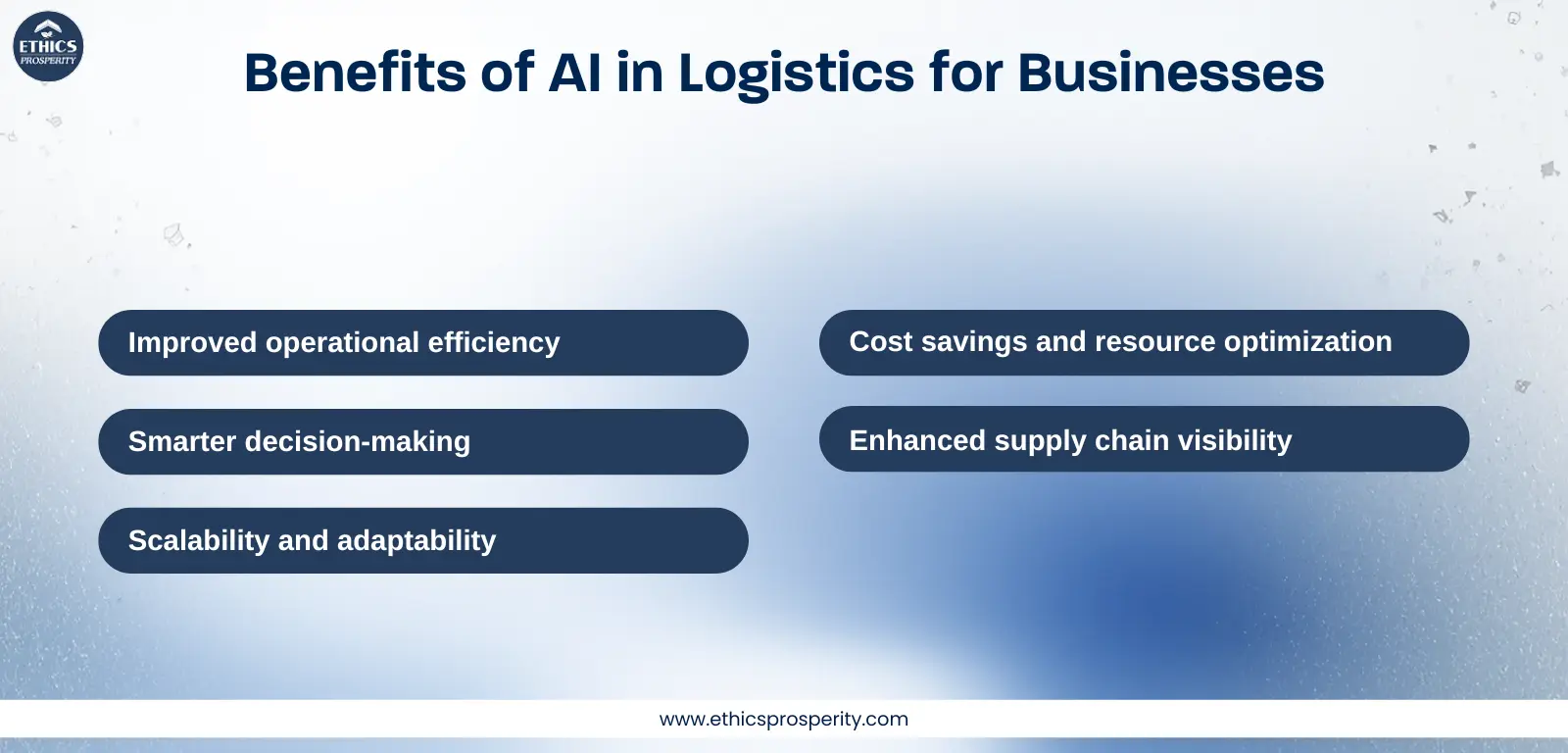
Implementing AI in logistics provides businesses with measurable advantages, helping improve efficiency, reduce costs, and make smarter decisions across the supply chain.
Benefits:
-
Improved operational efficiency – Intelligent Logistics automation streamlines workflows, reduces manual tasks, and accelerates operations.
-
Cost savings and resource optimization – AI optimizes inventory, labor, and transportation, lowering overall operational expenses.
-
Smarter decision-making – Advanced analytics turn complex data into actionable insights, improving planning, sourcing, and distribution through integrated Supply chain Solutions.
-
Enhanced supply chain visibility – AI combined with IOT enables real-time monitoring and faster response to disruptions, ensuring smooth operations.
-
Scalability and adaptability – AI systems can scale with business growth while maintaining consistent performance, preparing companies for future expansion and changing market demands.
By leveraging these benefits, organizations can create more resilient, efficient, and customer-focused Smart supply chains that support long-term growth and competitiveness.
Challenges and Limitations of AI in Logistics
Implementing AI in logistics offers major benefits, but businesses face several challenges and limitations that must be addressed for successful adoption.
Challenges:
-
High implementation costs – Deploying AI and integrating it with Logistics automation systems requires investment in technology, software, and skilled talent.
-
Workforce readiness – Employees need training to work effectively with AI-powered systems, ensuring human expertise complements automation.
-
Cybersecurity risks – Connected AI and IOT systems increase exposure to cyber threats, making robust security measures essential.
Limitations:
-
Data quality and integration – AI depends on accurate, consistent, and integrated data. Fragmented or poor-quality data can limit its predictive and optimization capabilities.
-
Balancing human oversight – AI automates many operations, but human judgment remains crucial for decisions requiring context, ethics, and strategy. Without proper oversight, automation can be ineffective or risky.
By understanding these challenges and limitations, organizations can better plan AI adoption, mitigate risks, and leverage its full potential to create more efficient and responsive Smart supply chains.
The Future of AI in Logistics and Supply Chain
The future of logistics will be shaped by AI in logistics, intelligent automation, and deeper digital integration, enabling supply chains to become faster, more resilient, and predictive. Smart supply chains will leverage AI to optimize transportation, inventory, and warehouse operations, anticipate disruptions, and improve real-time decision-making.
Advancements in Warehouse automation Systems will streamline order fulfillment, improve space utilization, and reduce errors, while expanded IOT connectivity provides continuous monitoring of inventory, vehicles, and equipment. This allows predictive maintenance, optimized last mile delivery, and enhanced operational efficiency, reducing costs and improving customer satisfaction.
Innovation in last mile delivery, including autonomous vehicles, drones, and AI-driven routing, will enhance delivery speed and reliability while optimizing fuel and resource usage. AI-powered Supply chain Solutions will also enable seamless collaboration between suppliers, manufacturers, and logistics providers, fostering transparency, agility, and sustainability. By integrating these technologies, logistics networks will become fully connected, adaptive, and efficient, helping businesses maintain competitiveness and consistently deliver superior customer experiences.
Final Thoughts
AI in logistics is now a strategic necessity for building efficient, resilient, and customer focused supply chains. By leveraging Logistics automation, advanced Supply chain Solutions, and IOT integration, organizations can boost productivity, reduce costs, and make smarter decisions. Businesses that adopt AI intelligently while embracing innovation and sustainability will create future ready Smart supply chains capable of meeting growing demand, maintaining competitiveness, and consistently delivering superior service.
When implemented responsibly and guided by values such as Ethics Prosperity, AI driven logistics can drive sustainable growth, empower teams and create long term value. Organizations that balance innovation with ethical responsibility will lead the future of smart logistics.