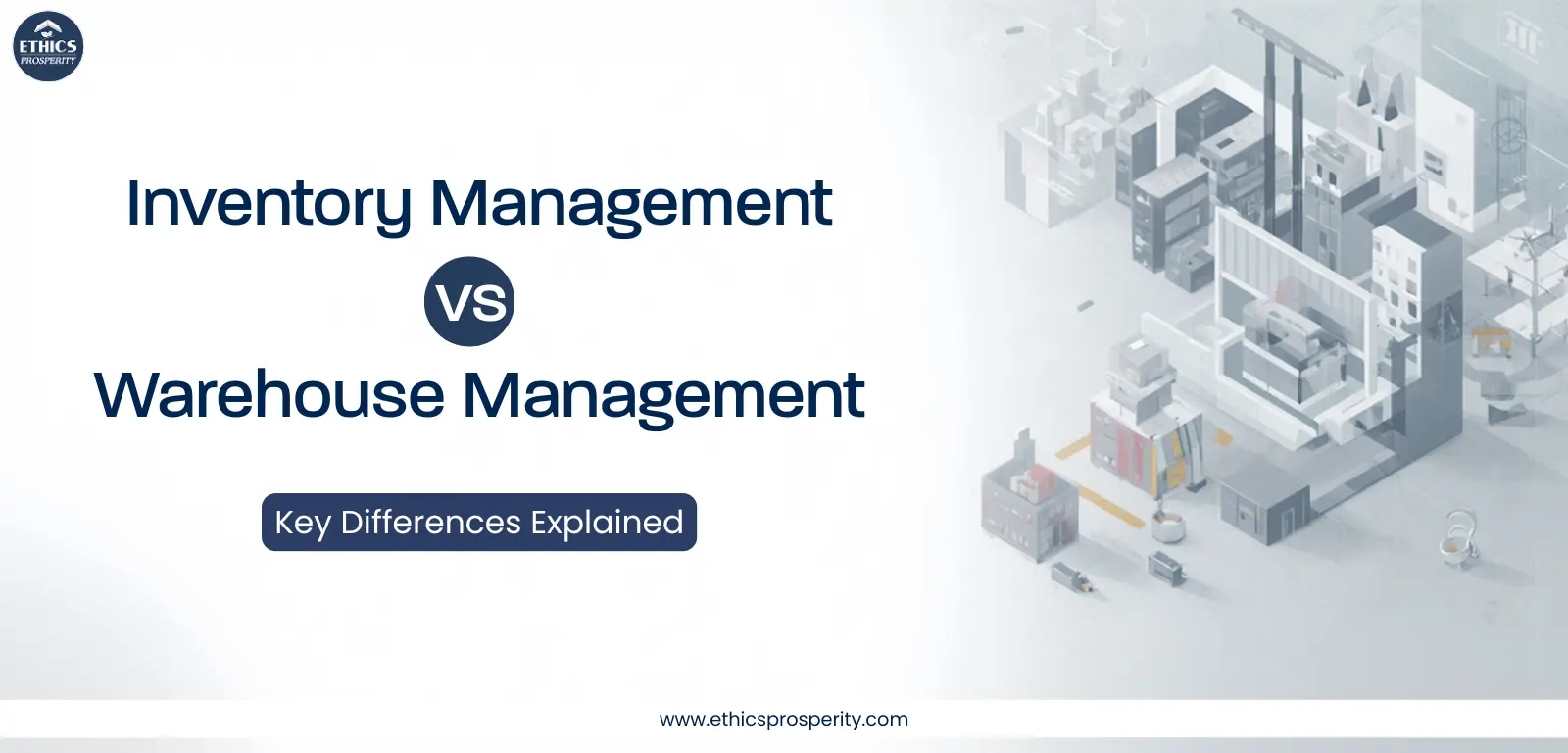
In today’s fast paced logistics and warehousing ecosystem, nearly 65% of supply chain costs are tied to warehousing and inventory activities, making efficiency a strategic priority. Inventory Management and Warehouse Management are two core pillars of end to end supply chain management, directly impacting cost control, service quality, and product availability.
Although closely linked, Inventory Management and Warehouse Management serve distinct roles. Organizations implementing end to end warehouse management solutions, supported by smart warehousing and warehouse automation systems, have achieved up to 30 percent improvement in order accuracy and 25% faster fulfillment, reinforcing the need to understand their differences.
What is Inventory Management?
Inventory Management focuses on tracking, controlling, and optimizing stock levels across the supply chain. Its primary objective is to ensure the right products are available in the right quantity, at the right time, while minimizing carrying costs and avoiding stockouts or overstocking.
Key Components of Inventory Management:
-
Inventory Tracking Systems – Tools such as ERP, barcode scanning, and RFID systems that provide real time visibility of stock levels and movement.
-
Demand Forecasting – Analyzing historical sales, market trends, and seasonality to predict future inventory requirements accurately.
-
Reorder Management – Setting optimal reorder points and managing order cycles to maintain balanced stock and prevent shortages or overstocking.
-
Safety Stock Management – Maintaining buffer inventory to safeguard against demand fluctuations, supplier delays, or unexpected disruptions.
-
Inventory Classification – Categorizing products based on importance, turnover rate, or value (e.g., ABC analysis) to prioritize resources and decision making.
-
Integration with Supply Chain Functions – Connecting inventory data with procurement, sales, logistics, and warehouse operations for synchronized planning and operations.
-
Reporting and Analytics – Using dashboards, KPIs, and performance metrics to monitor stock levels, turnover, and carrying costs for informed decision making.
Effective inventory management is a cornerstone of end-to-end supply chain management, enabling businesses to respond swiftly to market demand and customer expectations.
What is Warehouse Management?
Warehouse Management governs the physical handling of goods within a warehouse facility. It includes processes related to receiving, storing, picking, packing, and dispatching inventory efficiently and accurately.
Modern warehouse operations rely heavily on a Warehouse Management System (WMS) to improve visibility, accuracy, and operational control. With the rise of smart warehousing, companies are increasingly adopting warehouse automation systems such as robotics, conveyor systems, and AI-driven analytics.
Key Components of Warehouse Management:
-
Warehouse Management System – A centralized system that controls and monitors all warehouse operations, providing real time visibility, process automation, and data driven decision making.
-
Warehouse layout and infrastructure – The physical design of the warehouse includes racking, shelving, material handling equipment, and storage zones to support efficient movement and space utilization.
-
Inventory control and tracking – Accurate tracking of inventory through barcode, RFID, or automated systems to maintain stock accuracy and reduce discrepancies.
-
Workforce and labor management – Efficient allocation and monitoring of labor to improve productivity, manage workloads, and maintain operational consistency.
-
Automation and smart warehousing technologies – Use of warehouse automation systems such as conveyors, robotics, and AI based tools to enhance speed, accuracy, and scalability.
-
Cold storage and specialized facilities – Temperature controlled and compliant environments designed to handle sensitive, perishable, or regulated products.
-
Integration with logistics and distribution – Seamless connectivity with transportation, distribution management, and inventory systems to support end to end supply chain management.
Warehouse management plays a vital role in delivering seamless end-to-end warehouse management solutions, especially for sectors like FMCG, pharmaceuticals, and e-commerce.
Inventory Management vs Warehouse Management: A Comparative View
|
Aspect |
Inventory Management |
Warehouse Management |
|
Focus |
Stock levels and availability |
Physical storage and movement |
|
Scope |
Across the supply chain |
Within the warehouse |
|
Objective |
Reduce costs and prevent stock imbalance |
Improve operational efficiency |
|
Technology |
Inventory planning tools, ERP |
Warehouse Management System, automation |
|
Role in Supply Chain |
Strategic planning |
Execution and fulfillment |
While Inventory Management is more strategic and data-driven, Warehouse Management is operational and execution-focused. Together, they form the backbone of efficient logistics and warehousing operations.
How Inventory & Warehouse Management Work Together
Inventory Management and Warehouse Management are interdependent components of end to end supply chain management, working together to ensure uninterrupted product flow, optimal stock availability, and efficient order fulfillment. While Inventory Management focuses on planning, forecasting, and controlling stock levels, Warehouse Management is responsible for executing these plans through precise handling, storage, and movement of goods within the warehouse.
The integration of both functions through a centralized Warehouse Management System creates real time visibility across inventory and warehouse operations. Accurate inventory data guides warehouse activities such as slotting, picking, and replenishment, while warehouse execution data feeds back into inventory planning. This continuous data exchange reduces stock discrepancies, minimizes excess inventory, and prevents stockouts, resulting in improved operational control.
With the adoption of smart warehousing and advanced warehouse automation systems, the collaboration between Inventory Management and Warehouse Management becomes even more seamless. Automated picking systems, barcode and RFID tracking, and AI driven analytics enhance accuracy, speed, and traceability across logistics and warehousing processes. These capabilities are especially critical in specialized environments such as cold storage warehouses, where precise inventory control and strict compliance standards are essential.
Together,Inventory Management and Warehouse Management strengthen distribution management by ensuring faster order processing, improved service levels, and reduced fulfillment lead times. When aligned within end-to-end warehouse management solutions, they enable businesses to lower operating costs, improve customer satisfaction, and build a resilient and scalable supply chain capable of adapting to changing market demands.
Conclusion
Effective Inventory Management combined with efficient Warehouse Management is essential for smooth end to end supply chain management. Leveraging a Warehouse Management System, smart warehousing, and warehouse automation systems enhances stock control, fulfillment speed, and distribution management, even in cold storage warehouses.
At Ethics Prosperity, aligning inventory and warehouse operations drives long term growth, operational accuracy, and lasting success, building resilient and future ready supply chains.